Monday, 28 February 2022

Some self-portraits, 1922-1958


Self-portrait 1958 Oil on canvas (1'8" x 12": 49.5 x 29.4cm) Photograph: Petra van der Wal ©Christopher Campbell-Howes. Private collection.


There's often a slight mystery about artists' self-portraits. Something undefinable, something not quite right about the sitter, especially if you've known him or her personally. It may take a little time before it clicks, like an optical illusion falling into place. In Evelyn's case above, painted when she was a little over 50, she has dressed maybe a little less informally than she would have done for a day to be spent in her studio, but all the same there's something not quite faithful to her image. For one thing, the balance and ensemble of her facial features - no one's face is exactly symmetrical - has been changed. Nor was she left-handed. The explanation is simple. Evelyn is painting what she sees in the full length mirror she has brought into her studio. Left and right are reversed.
 
Evelyn is in her new studio. In the autumn of 1958 she and her husband Dr Roger Folley moved into Staple Farm, a farmhouse on the west-facing slopes of the North Downs near Hastingleigh, a village some miles south of Canterbury. She has not long moved in. There have been alterations, among them the addition of an upstairs studio, the first more than makeshift studio she has had since 1945. (How ironic that she should have only 18 months to enjoy it: she died in May 1960.) In a sense she is christening her studio with a self-portrait, the first for many years. In her youth she made several, but she lost the habit after leaving the Royal College of Art in 1933.
 
As always composition is paramount. Her image is based on an isosceles triangle which rises from a slew of legs - nine altogether, hers, the stool's and the easel's - to direct us to the head and the eye and the imagination of this remarkable artist.
 
Evelyn's first known self-portrait, with the same mirror-image reversal, dates from 1922, when she was 15. Here, among her palette and easel, she is maybe dreaming of her future as an artist. Her hand is extraordinarily assured for a 15-year-old.


Self-portrait 1922 Pencil. Ashmolean Museum, Oxford

Evelyn was in her late teens when she produced a self-portrait in a different vein:

'Girl with banjo': self-portrait playing the banjolele c.1925 Water-colour and charcoal Photograph ©Christopher Campbell-Howes. Private collection.

This probably refers to the housewarming party the Dunbar family gave to celebrate William Dunbar's (Evelyn's father) purchase of The Cedars, the family house in Strood. Two at least of the five Dunbar siblings played in a band for the occasion, Evelyn on banjolele (a cross between banjo and ukulele) and her older sister Marjorie on piano. Studies survive of several other band members, including a violinist and a concertina player. Here is Evelyn, who had a wide repertoire of the dance tunes and popular songs of the day, in full exuberance with the Charleston or Foxtrot or the Black Bottom, complete with period kiss curl. What fun.

At 21 she produced one of the very few female nude self-portraits in the history of art. At the time she was casting about for an art college to suit her, having had one or two false starts and subsequent drop-outs in Rochester and Chelsea. In 1929 she won an exhibition to the Royal College of Art, but it's unlikely that she submitted this self-portrait as part of her entry application portfolio.


Nude self-portrait Pencil and water-colour 1928 Inscribed 'May June/28' Photograph: Petra van der Wal © Liss LlewellynFine Art. Private collection.


We assume that this delicate water-colour is indeed a self-portrait because the inscription is in Evelyn's handwriting at that period, because she kept it all her life and because the provenance is impeccable. The modest rondeurs and texture of the buttocks are echoed in several mid-1930s letters to her fellow-artist and lover Charles Mahoney, who - hardly the first to do so - compared this feature to a peach, and vice versa. It came to light in a portfolio of other juvenilia - she was 21, nevertheless - in 2013, bundled up separately from the substantial quantity of Royal College of Art life school studies from a year or two later. Why did she paint it? In the summer of 1928 she was living at home, writing and illustrating children's books, not having found much satisfaction in the art college courses she had abandoned. In the absence of life classes, and maybe conscious of the louche reputation sometimes attaching itself to models, did Evelyn try to explore one of the great imperatives of figure drawing unofficially, in the comfort of her own bedroom? Perhaps we should ask no further questions, but simply enjoy this delicate water-colour essay into the nude with the subtly tinted flesh of an attractive 21-year-old woman.

Self portrait, c.1927 oil on canvas board. Photograph ©Liss Llewellyn

Here is Evelyn in her early 20s, at her easel, carefully observing herself in a mirror. Her floppy hat adds a hint of Bohemian style to her otherwise earnest expression. As the artist Tom Phillips noted, 'If self-portraits have a tendency to look glum it should not be surprising. As Rembrandt discovered, it is difficult to laugh and paint at the same time: the laugh or smile is acted and the eyes fail to join in, being themselves otherwise engaged.' As mentioned above the other dilemma is (since a mirror in usually involved) that the image an artist makes is the wrong way round.
 
Finally, from 1930 comes this rather severe self-portrait, in all probability submitted to her Royal College of Art tutors as part of a mid-course portfolio. Evelyn has grown up.

'Self Portrait Drawing' Watercolour, damaged with orange/brown stain. ?1930 (22" x 15": 56 x 38cm) Photograph: ©Christopher Campbell-Howes. Private collection.  


Many thanks to Paul Liss for his contribution to this essay.

Text ©Christopher Campbell-Howes 2022

Further reading...

EVELYN DUNBAR : A LIFE IN PAINTING
by Christopher Campbell-Howes

is available to order online from:

orders@scriptps.co.uk

448 pages, 301 illustrations. RRP £30


Sunday, 27 February 2022

The Cedars and its Garden Part 1 (1924-46)

The Cedars Oil on canvas c.1924 Photograph ©Liss Llewellyn. Private collection
 
 This is The Cedars, the Dunbar family home from 1924-46, most likely painted when Evelyn was 17. It's maybe not the most engaging painting to emerge from her juvenile studio, even from one who never showed much interest in painting buildings for their own sake, but it's an honest and workaday account of her new home. She kept it for the rest of her life, the only formal painting of any house she ever lived in.
 
 The Cedars, surely photographed some years before the exterior embellishments in Evelyn's rendering above.
 
The Cedars stood - and still stands - on rising ground in Strood, westernmost of the Medway Towns, across the river from Rochester. It was built some time after 1860 on the site of a windmill. Evelyn's father William Dunbar bought it in 1924 for £1800, a knockdown price, according to Alec Dunbar, which equates roughly to £110,000 today. Alec, the younger of Evelyn's two brothers, recorded this and other early insights into the Dunbar family in a racily breathless manuscript memoir entitled Never a Dull Moment. 
 
The tower, and the possibility of converting it into a studio, initially for his wife Florence and in due course for Evelyn, was probably a powerful factor in William Dunbar's decision to buy the property. It was high time: Florence's studio, improvised in the 'snug', a sort of fore-kitchen in the previous family house at 244, High Street, Rochester, was hardly conducive to serious painting, as an early drawing of Evelyn's shows:
 
The Artist and her Mother in the 'Snug' c.1922 pen and ink on paper Photograph ©LissLlewellyn

It's difficult to gauge the 'feel' of the interior of The Cedars from Evelyn's brush or pencil. She was never very interested in interiors. The people in them, yes, certainly, but rarely do we have an interior for its own sake. Our closest glimpse inside The Cedars comes perhaps in A Knitting Party, a 1940 painting for the War Artists' Advisory Committee, and even then Evelyn has enlarged the room with non-existent walls and bays in order to cram all the knitters in without jeopardising the balance of the painting.
 
 
A Knitting Party 1940 oil on canvas Imperial War Museum
 
Occasional images amplify the interior of The Cedars, but so little that I hesitate to include any. Here are two of several:
 
 Interior at The Cedars c. 1925 pen, ink and wash. Photograph©Liss Llewellyn

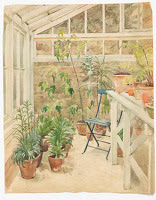
The Conservatory at The Cedars c.1929 water colour. Photograph©Liss Llewellyn
 
Sharp-eyed Dunbar aficionados may recognise this as the setting for Evelyn's 1930 Sketch for Decoration: Flight now (with the addition of Jessie Dunbar playing solo badminton) in Tate Britain.
 
* * *
 
William Dunbar died aged 70 in 1932. The rest of the family continued to live there until Alec left on his marriage in 1936. Florence died in 1944, Evelyn, the youngest of the siblings, left to live in Warwickshire with her husband Roger Folley in 1945. The three survivors, Ronald, Jessie and Marjorie, all unmarried, sold The Cedars in 1946 and went to live across the river in nearby Rochester.
 
For a while, and before it was converted into flats, The Cedars became a hotel, and indeed for a long time afterwards an exterior bracket lamp, visible from the road outside, carried - and maybe still carries - the legend 'The Cedars Hotel', the only remaining glimpse into its past.

As for the garden, not the slightest trace remains. It was laid to rest beneath the foundations, drains and infrastructure of an overcrowded, cheek-by-jowl housing estate. It only lives on through Evelyn's images of it.
 

(Text © Christopher Campbell-Howes 2019. All rights reserved.)

 
Further reading...

EVELYN DUNBAR : A LIFE IN PAINTING
by Christopher Campbell-Howes

is available to order online from:

orders@scriptps.co.uk

448 pages, 301 illustrations. RRP £30


Saturday, 26 February 2022

The Cedars and its Garden Part 2 (1924-46)


 Florence Dunbar in the Garden at The Cedars c.1938 oil on canvas Photograph: ©LissLlewellyn Private collection

The Dunbar family moved into The Cedars, a 17-roomed mid-Victorian house in Strood (the westernmost, trans-Medway area of Rochester, Kent) in 1924. I imagine the family was hugely content with William Dunbar's purchase and their new home; beforehand they had lived at 244, High Street, Rochester, a 4-storey house opposite the forecourt of the old Rochester railway station. Not many pictures survive of this house, but first impressions suggest that it was cramped and dark, with a limited garden area.

Here are the Dunbars soon after moving into The Cedars, all except William, who was presumably the photographer.

 The Dunbar family in the garden at The Cedars, 1924. Photo: Dunbar family archive.

Left to right they are: Ronald, the oldest of the siblings; Evelyn, the youngest, who would be 16 the following December; Felbridge, a sort of lurcher; Alec; Florence, their mother; Jessie and finally Marjorie (usually known as 'Midge'), born so close together in 1897/98 as to be almost twins. The family seems to me to express a dynamic of energetic unity, and it's this, for what it's worth, that encourages me to think that this photo was very probably taken on the day they moved into The Cedars...that, and the length and quality of the grass. Florence, a gardener to her green fingertips, would in normal circumstances never have allowed a lawn to grow to such a length, nor to have so many alien plants colonising it.

A background feature of this family photograph is the brick wall, which features in so many of Evelyn's garden images. Here's one of them:

Herbaceous Border at The Cedars c.1934 pen and wash on paper. Signed 'E.Dunbar'. Photograph ©LissLlewellyn (The date, c.1934, may be debatable: the garden path has not yet received its diagonally-laid brick edging. 1926 might be a better estimate.)

Here the garden, or that part of it lying against the brick wall, appears to be well established, no doubt due to the efforts of its handmaidens, maybe Evelyn herself in the foreground and Florence, almost hidden by the greenery just slightly right of centre in the middle ground. The diagonally-laid brick edging evident in later images was probably the work of a rather shadowy pair of gardeners, Alf and/or Bert. 


Alf and Bert: from letter to Charles Mahoney ('Darling Matey'), 20th October 1936. Tate Archive: ©Estate of Evelyn Dunbar

Which was Alf and which was Bert we shall probably never know, and we can only guess at the significance of the marionette strings. One, surnamed Clarke, was a fixture when William Dunbar bought The Cedars. In another letter to Mahoney, dated March 1936, Evelyn wrote '[...] we have another man in the garden to do an 8-hour day on Saturdays [...] He has been very highly recommended & is quite young and strong.' Pausing to note some Evelynish touches, the small change of her esprit, like the patches on Clarke's knees and the spotted handkerchief peeping out of his jacket pocket, we can perhaps assume that Alf and Bert occupied themselves mostly with the fruit and vegetables while Florence, and occasionally her daughters, looked after the ornamental garden.

Florence Dunbar was really the guiding spirit in the development of The Cedars garden. Here - for reference - she is again, as painted by Evelyn, waiting for spring to happen:

Florence Dunbar in the Garden at The Cedars c.1938 oil on canvas Photograph: ©LissLlewellyn Private collection    

It's a cold day in March or April. The first daffodils are flowering, more will follow. Beyond Florence, well wrapped under a plaid blanket and wearing her preferred gardening jacket, some beds of bare earth await her attentions. It's as though she can't wait to get started. Her vigil is shared by what is at first sight an inexplicable black lump in the left foreground, but which on closer examination turns out to be Paul, the Dunbar's Aberdeen terrier, the successor to Felbridge. 

Under the green-fingered Florence's guidance The Cedars garden quickly became Evelyn's abiding source of inspiration. For her it became a metaphor for the Bible-specified interaction between mankind and creator, a notion encapsulated in the story of the Garden of Eden. This garden concept fitted comfortably with Evelyn's - and her mother's - Christian Science, and continued to do so, greatly amplified, with the onset of World War 2; her employment as a war artist recording the agricultural work of the Women's Land Army extended her horizons far beyond an obscure garden in north Kent.

As if in tribute to Florence's influence, Evelyn includes her mother in several of her garden paintings.

 
The Garden at The Cedars oil on canvas c.1938 Photograph ©LissLlewellyn. Private collection

The Garden at The Cedars might also be the continuation of Florence Dunbar in the Garden at The Cedars, indeed it might record the very next day. Spring has sprung, Florence has abandoned her plaid for her fork, and is getting on with her devotions. We see her again on the extreme right in The Shed, in early summer mode.

The Shed oil on canvas c.1937. Private collection

And we find her again in Apple Blossom at The Cedars, still on the extreme right, still busy. (Follow the link for a fuller discussion.)


Apple Blossom at The Cedars c.1939 Photograph Bert Janssen ©Christopher Campbell-Howes. Private collection.

The most extensive of Evelyn's garden images is surely Winter Garden. The orientation is such that she might have painted it sitting in the open doorway of The Shed. Everything is there - the buttressed brick wall, the diagonally-laid brick path-edgings, the neatly trimmed lawn, the apple trees and of course The Cedars with its tower in the distance. No human figures, though. All gardens have their own personality, not necessarily reflecting the people who created them. Maybe Evelyn's rendering of The Cedars garden captures its own personality, rather than that of the dedicated people who dressed it and kept it. 

Winter Garden 1927-38. Signed 'Evelyn Dunbar'. Purchased by the Tate from the artist in 1939. Photograph ©Tate, London 2016


And just as well.  These images are the only records we have of it. The Cedars garden has disappeared. William Dunbar died in 1932, Alec Dunbar left home in 1936, Florence died in 1944. Evelyn left in 1945, to set up their first married home with her husband Roger Folley in Warwickshire. By the end of 1946 there was no longer a Dunbar presence at The Cedars; Ronald, Jessie and Marjorie had moved to a smaller property, The White House, in Frindsbury, a suburb of Strood. The Cedars was sold, and for a while became a hotel. In due course the garden ground was laid to rest beneath the foundations, drains and infrastructure of an overcrowded housing estate. The garden lives on only through Evelyn's images of it.

Warmest thanks to Paul Liss and Sarah Hill for their contributions.

Text ©Christopher Campbell-Howes 2022.


Further reading...

        EVELYN DUNBAR : A LIFE IN PAINTING
 
                by Christopher Campbell-Howes

                 is available to order online from:

                customerservices@scriptps.co.uk
 
             448 pages, 301 illustrations. RRP £30

Land Army Girls going to Bed & Women's Land Army Hostel (1943)

  Land Army Girls going to Bed 1943 (1'8" x 2' 6": 51 x 76cm) Imperial War Museum, London

Women's Land Army Hostel 1943 (9" x 9": 22.5 x 22.5cm) Russell-Cotes Art Gallery and Museum, Bournemouth

In the spring of 1943 Roger Folley, Evelyn's husband, was posted for training in night navigation and the use of in-flight radar to RAF Charterhall, in Berwickshire, Scotland. As usual Evelyn did her best to follow his postings, and for a few May weeks they lived in a rented cottage on a farm called Edington Mains, near the Borders village of Greenlaw. (The farmer's name was Clark: his son James, then a 7-year-old known as Jim, was later to win two World Formula 1 championships. Mr Clark took to Roger and his agricultural leanings, promising him, if he became a farmer after the war, to give him a bull calf.) During this time Evelyn spent a few days a short way south of the Border, in or near Wooler.

Four Women's Land Army paintings ensued from Evelyn's stay in the Borders. Two are exteriors: Potato Sorting, Berwick and Singling Turnips. The two interiors above are set just south of the Border: Of the two above, Land Army Girls going to Bed is probably set in an as yet unidentified country house near Wooler, and Women's Land Army Hostel is set in a purpose-built hostel dating from 1942, now the Wooler Youth Hostel. These interiors are unusual in that they show Land Girls off duty and not actually engaged in agricultural activities.

Before setting off for the Borders Evelyn had contacted the secretary of the Northumberland branch of the Women's Land Army, via Lady Gertrude Denham, Director of the WLA. Evelyn was warmly welcomed, according to a letter she wrote to Elmslie Owen, secretary of the War Artists' Advisory Committee: 'She [the Northumberland secretary] was very pleased to hear that I thought of going there, some of the best work is apparently done up there, and people hear and see little of it.' It's maybe a little ironic that the paintings shown here should be of Land Girls preparing to sleep or eat, but in fact the other two of the Borders quartet, Potato Sorting, Berwick and Singling Turnips show them engaged in uncomfortable and demanding work.

Having been given her credentials, Evelyn settled down to sketch and paint them. Who were these Land Girls?

By 1943, when Evelyn was painting these pictures, the Women's Land Army had largely overcome the strong opposition to employing Land Girls initially voiced by many farmers. Founded by Lady Denman in 1938 as war clouds gathered on the horizon, and based on a similar organisation in the 1914-18 war, the Women's Land Army gathered strength as the war progressed. There are many individual memoirs of service in the WLA, and Dr Gill Clarke, also Evelyn's biographer, has written a concise and readable account of it in her The Women's Land Army: A Portrait (Sansom & Co., Bristol, 2008).

At first the WLA was staffed by volunteers, but by December 1941 the shortage of manpower led the UK Government to conscript women. To be accepted for the WLA recruits had to be between 17 and 40, to be strong and healthy, fond of country life, not afraid of hard work, and prepared to serve for the duration of the war wherever they might be posted.

They came from all backgrounds, Wales, Scotland, Northern Ireland and England, rural and urban, and from all levels of a British society maybe more, or at least differently, class-stratified than today. Gill Clarke quotes Vita Sackville-West's (an acquaintance of Evelyn in her later years) account of the background of recuits: 'She has been a shop assistant, a manicurist, a hair-dresser, a short-hand typist, a ballet-dancer, a milliner, a mannequin, a saleswoman, an insurance clerk...'

Their first names, all taken from the many former Land Girls who have recorded their experiences, give a sense of period: there are Gwens, Sheilas, Dorothys, Margarets, Joys and Joyces, Eileens, Audreys, Clarices, Muriels, Fredas, Maureens, Gladyses, Doreens, Queenies, Irises and Graces, Veras and Hildas. This isn't the place to discuss the outcomes of the social mixing the WLA gave rise to, and the affirmation by the WLA - and other organisations like the Auxiliary Territorial Service (ATS, the women's branch of the British army) and the Women's Royal Naval Service (WRNS) - of the future place of women in British society would be a digression from Evelyn's painting. Even so, some months after Evelyn's Borders expedition, she was commissioned to record the activities of the Women's Auxiliary Air Force (WAAF).

The majority of Land Girls lived in purpose-built hostels, otherwise large country houses put at their disposal for the duration of the war. Evelyn has chosen a bedroom probably on the first floor - note the size of the window - of a Northumberland country house for Land Army Girls going to Bed, a room spacious enough for at least 4 bunk beds. There's a girls' dormitory atmosphere about it - at least, I suppose so: I have to declare a working ignorance of girls' dormitories. As in several of her interiors it's difficult to work out exactly where Evelyn has placed herself to record this scene and make it into a viable and striking composition.

Many viewers will have problems with the perspective, and as many will say that it's mere cavilling to observe that the lower of the left-hand bunks doesn't match the one above it; and the joint between the foot and the side rail is conveniently obscured by what some might call a chairdrobe, hung with a pair of shoulder-strapped regulation khaki dungarees and a camisole. There's another possibility: has there been some larking about? Has Evelyn deliberately hidden the wonky joint, because in an access of high spirits one of the Land Girls shown here has bust it by jumping on it? Has Evelyn been sworn not to tell?

Never mind, there are other unsuspected accuracies. These hostels were very strictly run, with a curfew requiring Land Girls to be indoors by 10pm. Presumably, then, this scene must be taking place after curfew, say 10.30-11.00pm. But it's still light: how can this be, even allowing for the fact that the further north you go in the summer months, the shorter the nights become? In order to tally with what we know of Evelyn's movements in the Borders, the month is May, 1943. Suddenly the penny drops, the light dawns: throughout the war years Double British Summer Time was in operation, and the time by the clock is two hours in advance of Greenwich Mean Time. What is 8.30pm by the sun is 10.30pm by Big Ben and the hostel clock.

No one has drawn the curtains, so presumably the bedroom isn't overlooked. Corner posts are hung with greatcoats, maybe a reminder that summer hasn't entirely arrived and that on the East Coast the wind coming in off the sea can be cruel, even in spring. Draw-string bags slung from the bed posts presumably hold shoes. The girl in the lower bunk is applying cold cream to her face, a common practice at the time, before settling down.

The exact centre of the painting is occupied by a pair of fleece-lined slippers, and this is curious: Evelyn herself often wore slippers just of this type. I'm not of course suggesting that it's deliberate, but bedroom slippers also lead us, with Evelyn's usual left-to-right travel, into Women's Land Army Hostel. Worn by the Land Girl at the end of the canteen queue, they're bright blue, and this little painting, only 9" by 9", is possibly the most colourful of all Evelyn's WAAC paintings. She evokes a lively sense of cheerfulness and camaraderie. The Land Girls, queueing for their evening meal, are not long off duty: few, if any, have changed out of their working uniform, although we can imagine a back room somewhere full of muddy boots. The supply of full Women's Land Army uniform was notoriously erratic, and many of the girls here have improvised their own tops, which adds to the colour, along with the peonies on top of the radio (almost universally called the wireless in 1943) in the top left hand corner.

It doesn't take much imagination to hear the surround sound, the chatter, the laughter, the retelling of the day's events, the clatter from the kitchen, the banter between Land Girls and canteen staff as they dish up what appears to be a staple of canteen food, sausage and mashed potatoes. Or it might be another standby, spam fritters, slices of supposedly pork luncheon meat fried in its own fat. Nor should we forget the horseshoe, hung from the ceiling at an angle, so that the luck it's supposed to hold doesn't spill out.

Given my occasional attempts in these commentaries to associate, rightly or wrongly, Evelyn's war paintings with the progress of the war, it's not hard to link the ambience of Women's Land Army Hostel with what was going on in the wider world. Within the tumultuous week May 12th - 19th, 1943, the famous RAF Dambusters raid had taken place, destroying the water supply to Germany's industrial heartland, the Ruhr. The surrender of 150,000 German and Italian troops in Tunisia marked the end of the North African campaign. The encouraging end-of-the-month statistics of merchant ship losses showed the U-boat menace was being mastered. In a wary and circumspect way, maybe at last there were things to be cheerful about.

Many thanks to Carol Whinnom, of Berwick Museum and Art Gallery, for her help.
 
(Text © Christopher Campbell-Howes 2022. All rights reserved.)

Further reading...

        EVELYN DUNBAR : A LIFE IN PAINTING
 
                by Christopher Campbell-Howes

                is available to order online from:

              customerservices@scriptps.co.uk

           448 pages, 301 illustrations. RRP £30