Sunday, 6 November 2022

Evelyn's Farmers Weekly quiz (1954)


Farmers Weekly puzzle chart quiz: March 1954
 
In 1954 Evelyn was commissioned by the magazine Farmers Weekly to contribute to a regular feature called The Farming Year: Farmers Weekly Puzzle Chart. Perhaps they came out every month: Evelyn's is dated March 1954.
 
Competitors were asked to identify each of the activities shown and to indicate at which time of year - Winter, Spring, early Summer, late Summer, Autumn - each might take place. A further five activities, not among those illustrated, were to be suggested by the competitor, one for each of the specified times of year.  Answers on a postcard, etc. It wasn't stated what the prize(s) might be. To the eyes of modern quiz-folk it must all seem rather clunky. 
 
Shown is Evelyn's proof copy of what must have been a double page spread, as found in 2013 among her residual papers stored in a Kentish oasthouse since her death in 1960. If you have the means to enlarge it, well and good. If not, I'm sorry to be unable to reproduce a more legible image. But even in its unredeemed state - one might almost say un-ironed - the pen-and-ink draughtsmanship is exquisite, a culmination of so many of her agricultural images since her time as a war artist closely involved with the Women's Land Army. Indeed, one of her images comes straight from her war years: No. 7 harks back to Singling Turnips, recorded on a Berwickshire farm in the spring of 1943:
 
Singling Turnips 1943 Oil on canvas Photograph ©England & Co. Private collection
 
These pen-and-ink drawings are the last in a short series of farming images. The most extensive was A Book of Farmcraft (Longmans, London, 1942) written by Michael Greenhill, senior instructor at Sparsholt Agricultural Institute, Hampshire, where Evelyn was posted in 1940 to record Land Girls in training. We see the same very careful draughtmanship in some of her illustrations for A Book of Farmcraft, which sold over 40,000 copies.
 

Illustrations from A Book of Farmcraft. (But might one of the questions in the Farmers Weekly quiz feature a certain right/wrong anomaly?)
 
 A Book of Farmcraft was followed several years later by A Farm Dictionary (Evans Brothers, London, 1953). Derek Chapman, a senior instructor at the College of Estate Management in Reading, wanted to compile an entry-level dictionary of farming terms. Chapman knew both Dr Roger Folley, Evelyn's husband, and her A Book of Farmcraft; the circle was squared; Evelyn apparently was very happy to contribute to a sympathetic project emanating from Reading, the town in which she had been born. Accordingly she produced almost 100 small drawings, some done with the same concentration as those in the Farmers Weekly quiz above (see Oast-house in the selection below), others in which her lightness of touch is the foil to some little witticism or joke, as in Lean-to or Smoker below.


Copies of A Farm Dictionary, which was the last book Evelyn illustrated, are extremely rare. Occasionally Evelyn's studies for individual drawings, survivors from some 60 years of storage in far from ideal conditions, come up for sale. 

Text ©Christopher Campbell-Howes 2022. All rights reserved.
 
 
Further reading...

      EVELYN DUNBAR : A LIFE IN PAINTING
 
              by Christopher Campbell-Howes

              is available to order online from:

             customerservices@scriptps.co.uk

          448 pages, 301 illustrations. RRP £30


Monday, 31 October 2022

Double vision: Wye from Olantigh (1952-3)

 Wye from Olantigh (autumn) Oil on canvas ?1952 Private collection

Olantigh (pronounced Òll-en-ti), a name as ancient as any in East Kent, is a settlement about a mile north of the village of Wye consisting of a few cottages, a large country house and the surrounding parkland.

Evelyn and her husband Roger Folley left Oxford and moved to Kent in 1950. Roger Folley had recently been appointed as a lecturer in horticultural economics at Wye College, the agricultural campus of Imperial College, London. It was a big step up for him, but Evelyn deeply regretted leaving Oxford, her teaching posts at the Oxford School of Art and the Ruskin School and the artistic coterie she delighted in and whose influence contributed to the most fertile and expressive period of her life.

They rented The Elms, an isolated house on the edge of Hinxhill, a tiny satellite of Ashford, in Kent. With time on her hands Evelyn set out from The Elms to explore the neighbourhood, sometimes in their Morris Oxford Traveller, when easels, paints and brushes had to be carried, sometimes on her bicycle, sometimes on foot when all that needed to be carried were sketch pads and charcoal. Landscape began to preoccupy her to an extent she hadn't known before. The landscapes from the last few years of her life outnumber the combined total from her earlier periods.

At some stage in the early 1950s Evelyn's exploration of the countryside surrounding Wye and The Elms took her to Olantigh Park. One glance, surely, between those repoussoir trees, with Wye church rising above the intervening woodland (and - though hardly visible here - the distant tower on the horizon of St Mary the Virgin in Ashford, done with the minutest of brushes) - one glance to suggest to Evelyn that here was a landscape modest in its sweep, at once intimate and universal, the hand of man equally evident with the hand of the creator, with or without a capital C. In fact a 'landscape worked and loved in equal measure', to quote a message I once discovered embedded in a wall in the Outer Hebrides, about as far as one can get within the British Isles from East Kent, but which I thought admirably summed up what Evelyn looked for in a landscape.

I'm inclined to think Wye from Olantigh (above) dates from the autumn of 1952, only because, and for lack of other evidence, Evelyn mounted a solo exhibition, the only one of her career, in Wye in December 1953. Had the painting above been shown, the paint would hardly have been dry. More reasonable, in this context, to assign it to the autumn of 1952. Perhaps it doesn't matter very much. There are more interesting questions to mull over, like which came first, because there are two accounts of Wye from Olantigh. Here is the pair:

Wye from Olantigh (summer) Oil on canvas 1953 Private collection

This version was the subject of a fairly full essay here. It came as a very pleasant surprise to learn that Evelyn had painted two versions of the same scene. The summer version has been in the same family since 1960, the autumn version similarly but unknown to me until recently. It is as though these beatific visions of English landscape keep pace with our age.

Many thanks to Anne Skilbeck for her assistance.

Text ©Christopher Campbell-Howes 2022. All rights reserved.


Further reading...

     EVELYN DUNBAR : A LIFE IN PAINTING
 
              by Christopher Campbell-Howes

              is available to order online from:

             customerservices@scriptps.co.uk

          448 pages, 301 illustrations. RRP £30

Sunday, 23 October 2022

Women's Auxiliary Air Force Store (1944)


 Women's Auxiliary Air Force Store 1944 Oil on canvas (1' 4" x 1' 8": 40.6 x 50.8 cm) Kelvingrove Art Gallery and Museum, Glasgow

In the summer of 1944, while Allied troops were fighting furiously to drive the Germans out of Normandy, Evelyn spent some weeks carrying out a commission by her employers, the War Artists' Advisory Committee, to record the activities of the Women's Auxiliary Air Force (WAAF). Perhaps with some intervention from her RAF officer husband Roger Folley, then serving with 488 (NZ) Squadron at RAF Colerne, in Wiltshire, she set up her easel at nearby RAF South Cerney. Her visit was not a success. Despite the WAAF being popularly, and proudly, presented as working on equal terms (apart from combat) with the men of the RAF, she was barred from access to operational areas. Her experience was thus restricted to observing and recording ancillary activity centres, the canteen, the sick bay and - as here - the clothing store. Nevertheless it was here that she found, or had been directed towards, something quite extraordinary, something unexpectedly problematic and potent in her promotion of women's interests and improvement of their status. It has to be said, however, that the problem had been solved by the time Evelyn submitted this painting in January 1946, some months after the war had ended.
 
* * *

Evelyn has taken her stepladder to give a top-down view of a WAAF clothing store. The central figure is especially interesting. Her single-strip epaulette slide shows she holds a commissioned WAAAF (three As, please note) rank, that of Section Officer, while her shoulder flash reads, unexpectedly, AUSTRALIA. What is she doing here, on the other side of the world from her home, in a clothing store?


 Women's Auxiliary Air Force Store: Detail showing 'AUSTRALIA' shoulder flash
 
She would have volunteered for the WAAAF, possibly in response to the threat from Japan, some time after March 1941. The WAAAF training centre in Melbourne, to which she would have been posted, instructed aircraft maintenance staff, munitions workers, electricians, telegraphists, radar operatives and staff in many other areas requiring high levels of technical and scientific skill. She would have been paid at least one third less than RAAF male staff in equivalent positions.We don't know in what technical or scientific skill our WAAAF officer has been trained, but it's unlikely to have been the supervision of a clothing store in southern England. As far as is known, she is the only Australian WAAAF officer to have been painted by a British war artist. We don't know who she was.
 
Let's look more closely at this clothing store. It has an air of desperation about it, as though the clothing store at RAF South Cerney was the only place in which a married, female civilian artist with slightly bohemian leanings might safely be let loose.
 
It's a gloomy, prison-like place. It's not certain where the light comes from; certainly not from the tiny windows set high in the walls. Maybe we have one of Evelyn's visual puns, a particularly powerful one: the light comes from Evelyn herself, from the direction in which she, the artist, is casting light - as we shall see in a moment - on a contentious problem most keenly evident in a clothing store. 
 
There are three theatres of action. On the extreme centre left a WAAF is trying on a tunic that appears to be too large for her. She bears some resemblance to a WAAF whose portrait Evelyn painted while at RAF South Cerney, entitling it Portrait of an Airwoman, which now hangs in the RAF Museum, Hendon. It's not the best portrait she ever painted, but perhaps in this also Evelyn was making a point: her tunic is just as lumpy as in the clothing store picture (if indeed she is the subject), we can be happy for her Airwoman that her rosebud lips pass muster and that her engagement ring points to a brighter future, but that forearm chevron, denoting Good Conduct...well, we're not very far from Brownie badges and certain top-down attitudes that did not exist in the parent service, the all-male RAF.
 
Portrait of an Airwoman 1944 RAF Museum, Hendon
 
The second theatre of action concentrates on the extreme right, where a trousered figure, maybe indicating a change of attitudes to women's wear at institutional level, is poking disconsolately at discarded clothing which World War 2 RAF uniform buffs may be better able to identify than I am able to, though similarly baffled by the pink strips.

We're led into the third and principal theatre of action by one of Evelyn's SW-NE diagonals, in this case a queue of WAAFs. The queue leader, whose neckwear is ambiguous, is pointing very obviously at the collar of her blouse or shirt, while the Australian Section Officer looks on rather blankly. 
 
As well she might. She is dealing with a recurring problem, legendary at the time among British WAAFs; that Evelyn has chosen to paint it is authentification in itself. The pale blue uniform shirts, to which separate collars were attached by means of studs, were cut to men's sizes and shapes. This meant that a shirt with a chest measurement generous enough to accommodate WAAF busts had a collar measurement correspondingly larger than the female neck it was supposed to enclose, so that it was impossible to do up the black uniform necktie without leaving an ugly and draughty gap between throat and collar stud. To combat this unthinking chauvinism many WAAFs preferred to buy their own blouses privately, trusting to a colour match acceptable to Section Officers and suchlike. We are not told how our Australian dealt with the problem. It's enough that we should be made aware of it.

Evelyn didn't enjoy her time at RAF South Cerney. She complained to E.C.Gregory, then secretary of the War Artists' Advisory Committee, that despite official security clearance she wasn't allowed to record WAAF activities in operational areas. This restricted her activities to such an extent that her only output from the time she spent at RAF South Cerney was Women's Auxiliary Air Force Store and several portraits of WAAFs and nurses associated with the RAF. 
 
I think Evelyn felt diffident about this picture. Maybe signing it 'E.D.' instead of her usual 'Evelyn Dunbar' points to this uncertainty. The problem over gender-sizing, prevalent in the earlier 1940s, had largely gone away by the time she finished painting it. With a non-existent problem to highlight the picture had lost its point and its impact. In fact Women's Auxiliary Air Force Store was the last of Evelyn's war paintings to be submitted: painted in the early autumn of 1944, it was not handed in until January 1946. But she hasn't wasted her time: of all her wartime images (perhaps A Land Girl and the Bail Bull) Women's Auxiliary Air Force Store carries the strongest messages of the perceived inferior status of women and the pressing need to do something about it. 

With many thanks to Penny Summerfield for her help.


(Text © Christopher Campbell-Howes 2022. All rights reserved.)


Further reading...

        EVELYN DUNBAR : A LIFE IN PAINTING
  
                by Christopher Campbell-Howes

                is available to order online from:

              customerservices@scriptps.co.uk

            448 pages, 301 illustrations. RRP £30


Friday, 21 October 2022

Why is the dresser wearing trousers? (1940)

Putting on Anti-gas Protective Clothing 1940 Imperial War Museum, London

We've seen this before, the first of Evelyn's war paintings, looked at in some detail here. That commentary wasn't entirely exhaustive, however, because there was one element that I didn't explore: the first indication that I think Evelyn gave of a deep and significant personal message evident in some of her war painting. It's in this context that I want to look more closely at the secondary figure in Putting on Anti-Gas Protective Clothing, that of the dresser. But first, a glance behind the scenes.

* * *

Two days after her 33rd birthday, in December 1939, Evelyn applied to be considered for appointment as a war artist at the suggestion of Sir William Rothenstein, former Principal of the Royal College of Art. Rothenstein had been impressed with Evelyn's gifts and promise since she started studying at the RCA in 1929. Known for looking after his former students, he remained on friendly terms with Evelyn until his death in 1945; he's likely to have been a smiling presence in the wings when her candidature came up for discussion by the War Artists' Advisory Committee (WAAC) in the early months of 1940.

The 11-strong, all male WAAC, whose average age in 1940 was under 60, can't have known very much about Evelyn. The chairman, Kenneth Clark, had come across her work once (but scroll down), and had hardly warmed to it. Percy Jowett, current RCA Principal and another WAAC member, to whom Evelyn applied, appeared to know of her work: on her application letter he wrote '...a very fine artist who has done excellent decorations as well as drawings', a perceptive and welcome commendation without being particularly illuminating.

For the WAAC the months between Evelyn's application and her acceptance (and that of Dorothy Coke and Ethel Gabain, together with Evelyn the first women war artists to be appointed) were marked by a certain non-commitment in coming to terms with the employment of women artists. Pressure on the WAAC to do so came notably from Lady Florence Norman, a founder trustee of the Imperial War Museum. For Evelyn those months, December 1939 - April 1940, were rather different.

* * *

168, High Street, Rochester, in a later incarnation, c.1952. The first floor windows illuminated Evelyn's The Blue Gallery.

 On the floor above The Fancy Shop, her sisters' haberdashery shop at 168 High Street, Rochester, was a large, handsome, blue-panelled room running the frontage length of the shop below. A year earlier, in February 1939, Evelyn opened what she called The Blue Gallery in this room with an exhibition of local artists' work together with work by leading contemporary artists of the time, some now better known than others: Edward Bawden, Barnett Freedman, Allan Gwynne-Jones, Kenneth Rowntree...and Charles Mahoney.

That Mahoney was asked to contribute was perhaps typical of Evelyn's generosity of spirit. He and Evelyn had had a disastrous relationship, one that in terms of her career brought few benefits. In 1932-33, her postgraduate year at the RCA, Mahoney had been her mural tutor, partly as a result of which she volunteered to join his team to decorate Brockley School for Boys (now Prendergast - Hilly Fields School) in south-east London. To start with no one else volunteered. Maybe it was hardly surprising: remuneration was suspiciously vague, and the locus being a school the viewing public would be limited to pupils and staff. Nor could the finished work go on display elsewhere. For young artists at the start of their careers it was a dead end. However late in 1933 two other recent graduates joined in for a limited period, and discovered that in the meantime Evelyn and Mahoney had fallen in love. 

However promising at first, their relationship was blighted by each having very different characters and backgrounds, Evelyn a cheerfully committed Christian Scientist from a bourgeois merchant background, Mahoney a disputatious atheist leaning far to the left politically. Both however shared a deep love of plants and gardening. Evelyn's self-effacing attempts to form a personal and professional unity with Mahoney failed, all except one: their joint production, Gardeners' Choice. They separated in 1937. A miscarriage marked the end of their relationship. Evelyn retreated to the bosom of her family. Her commitment to Mahoney, which included burying herself in the obscurity of Brockley for three years, had hardly enabled her career to get into second gear. 

Evelyn's return to The Cedars led her to think of herself as a cuckoo in the family nest. She refers to herself as such in the autobiographical April of 1938. Kindly people though the Dunbars were, there were certain understandable tensions within the family: her siblings had left school years before - the eldest, Ronald, had fought through World War 1 in a kilted regiment - and had since become hard-working shopkeepers and entrepreneurs, all contributing to the household expenses; Evelyn had had some 7 years'-worth of further education, with nothing material to show for it. And no money. April is the earliest of a short series of boxed images, as though Evelyn wanted to build protective walls round herself. Joseph's Dream of 1938 is another. To ease family tensions she agreed to work behind the counter in her sisters' shop, selling ribbons and buttons and contributing to occasional window displays. Her final effort to restore her career as an artist was The Blue Gallery. It was a dismal failure. It closed two months later without a single work having been sold. Well might Evelyn call this period her 'crisis' years. She returned to the haberdashery counter. Upstairs The Blue Gallery remained unvisited, except by Evelyn herself, who occasionally used it as a studio. It may well be that during the next few years some of her war paintings were produced there.

Her appointment as a war artist was met with delight, relief and determination to give the best value for money. The letters held in the Imperial War Museum to Ted Dickey, the WAAC secretary, in this context are deferential, almost servile. For the moment she had no money at all and had to apply to Dickey for an advance for travel and materials to undertake her first commission. For this she had to travel to Marlow, in Buckinghamshire, where at Bisham Abbey there was a training centre given over to the Women's Voluntary Service, at that time given some Civil Defence responsibility for organising anti-gas precautions.

* * *

Why is Evelyn's dresser wearing trousers?

No identities are given to the two women in Putting on Anti-Gas Protective Clothing (which, maybe significantly, continues the boxed presentation which marks some of her work during her 'crisis' years). The dresser is very simply drawn. By box 4, however, we notice something curious, presumably included deliberately by Evelyn: she is wearing the colours, slightly muted, of the Union Jack. She stands for the women of Britain, about to be protected by the dressee. The simplicity of her dress contrasts strongly with the ferociously awkward folds and creases she is helping the anti-gas nurse or ambulance driver to get into. The dresser is wearing trousers, which she probably called slacks, and this is really quite surprising, because even in 1940 it was far from universal for women to wear trousers. Indeed the wearing of them was widely mocked and disparaged.

In the 9-frame set of preparatory sketches below for Putting on Anti-Gas Protective Clothing the dresser is wearing some kind of dress or overall. Certainly not slacks. Why has Evelyn changed her mind? 

Sketch for Putting on Anti-Gas Protective Clothing (detail) Pencil 1940 Photograph ©LissLlewellyn
 

By the late 1930s the wearing of trousers tended to be limited to younger middle class women, as leisure wear primarily. It's perhaps noteworthy that the women's fashion magazine Vogue first featured slacks in 1939. As a random sample record, the wartime diarist Nella Last noted the trend and what it might indicate: a little later she wrote 'I suddenly thought tonight, "I know why a lot of women have gone into pants [i.e. slacks, trousers] - it's a sign that they are asserting themselves in some way." I feel pants are more a sign of the times than I realised.' So is Evelyn's maybe last-minute presentation of her slacks-wearing dresser intentional or unintentional?

Evelyn herself frequently wore slacks, although her slacks-wearing iconography is meagre:


Here she is posing for The Morning Post (later incorporated in The Daily Telegraph) in February 1936, standing on a scaffold pretending to paint a Brockley Mural image completed three years earlier...

 
...and here she is again in the persona of a mouse (she frequently did this as a young woman) in a June 1933 letter to Mahoney. Dressed in painting smock and slacks she is carrying plans for an extension of the Brockley Mural scheme.  (Detail from a letter held in the Tate Archive.)

This is not for one moment intended to suggest that the slack-wearing, ever-modest Evelyn brazenly styled herself as the dresser in Putting on Anti-gas Protective Clothing - far from it; she had only been in post a few weeks - but that she had come up with something much more subtly powerful: through her image of the unobtrusive dresser she had enlisted into the national effort that entire cohort of younger women to which she herself belonged. No mean feat for her first commission as a war artist.


Text ©Christopher Campbell-Howes 2022. All rights reserved.


Further reading...

     EVELYN DUNBAR : A LIFE IN PAINTING
 
             by Christopher Campbell-Howes

              is available to order online from:

             customerservices@scriptps.co.uk

         448 pages, 301 illustrations. RRP £30


Thursday, 11 August 2022

Sidelands (1959)


Sidelands Oil on canvas 1960 Location unknown
 
There's a certain pathos about this incomplete image. 'Sidelands' is the name of a farm at the foot of the North Downs a mile or two to the east of the village of Wye, in Kent. It would have been well known to Evelyn, whose husband Roger Folley lectured on horticultural economics at Wye College, a post which often included a close liaison with local farms.
 
To sketch it prior to painting Evelyn would have had to drive the few miles down the road to Wye from Hastingleigh, where she and Roger lived at Staple Farm. She may have cycled, but while the downhill run is easy, it's a stiffish climb back up to Staple Farm, and in 1959 Evelyn's heart wasn't in a very good condition. 
 
Sidelands stood on an easel in Evelyn's studio when she died, in May 1960. Its studio neighbours were Jacob's Dream, which also incorporates local landscape, and Autumn and the Poet. To me the season - always a vital element in Evelyn's paintings - suggests late summer or early autumn, so it's possible that she was painting Sidelands in September or October 1959.
 
After Evelyn's death Roger Folley collected her residual studio together, packed it in boxes and portfolios and consigned most of it to Alec Dunbar, the younger of her two brothers and the only Dunbar sibling with room to house it. However Roger Folley kept back a handful, maybe more, of Evelyn's paintings, some for sale (like Jacob's Dream), some family portraits and some local landscapes (like Wye from Olantigh) including the unfinished Sidelands. 
 
In the early 2000s Roger made a gift of several of Evelyn's paintings still in his care, particularly any with a local agricultural or horticultural context, to Wye College Senior Common Room. I don't know the terms of the gift, if any, but they hung in corridors and lecturing staff offices for several years, until Wye College closed down in 2009. Imperial College, London, of which Wye College had been the agricultural campus, assumed ownership of Evelyn's paintings, among them the magnificent An English Calendar, and transferred them to its London premises. Not all of them made it: Evelyn's little Land Girl Milking was reported by the Kensington and Chelsea Gazette as having been stolen from a private address in May 2010.


Land Girl Milking Oil on canvas 1940 Location unknown
 
Before making the donations to Wye College Senior Common Room, Roger Folley had photographs taken of the pictures he intended to give. These included Land Girl Milking, above, and (very suitably) Market Garden at Naaldwijk, the only painting Evelyn completed outside of the United Kingdom. I believe, although I'm happily open to correction, that Market Garden at Naaldwijk was shown at the 2006 Evelyn Dunbar exhibition at the St Barbe Museum and Art Gallery, Lymington, curated by Dr Gill Clarke and timed to coincide with publication of her biography Evelyn Dunbar: War and Country.
 
                                
 Market Garden at Naaldwijk 1957 Oil on canvas Location unknown

But what of Sidelands? Roger Folley himself took the photo at the top of this essay. He was approaching 90 and almost blind. The picture was taken outside, propped on a dustbin or similar and photographed. He could not see that he had inadvertently missed maybe three-quarters of the painting. Satisfied that he had kept a record of something that was about to pass out of his stewardship, he put his photo in a folder, along with the other images mentioned here, which subsequently came to me.

Until it comes to light, this is all we have of Sidelands. Maybe fortuitously we have the essence of Evelyn's message: the gate is open, wide open, for us to pass through into the organised and productive land beyond; the land, the creator's gift (capital C optional) to mankind, is being looked after on the terms in which the gift was made. There is no exclusion: the gift is for all mankind, on condition that it is looked after with industry, intelligence and love. Suppose she had painted Sidelands with the gate shut? What a different, negative message that would have carried. 

Text ©Christopher Campbell-Howes 2022


Further reading...

        EVELYN DUNBAR : A LIFE IN PAINTING
 
               by Christopher Campbell-Howes

               is available to order online from:

              customerservices@scriptps.co.uk
 
           448 pages, 301 illustrations. RRP £30


Tuesday, 9 August 2022

Autumn and the Poet (1960)


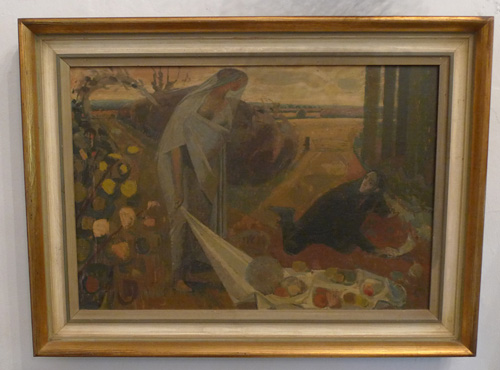
Evelyn Dunbar Autumn and the Poet (1960) Maidstone Museum & Bentlif Art Gallery, Maidstone, Kent

Evelyn worked sporadically on Autumn and the Poet for the best part of 12 years. She began it when she and her husband Roger were living in Enstone, a village in Oxfordshire. It was on one of the easels in her studio at Staple Farm, Hastingleigh, in Kent, when she died in May, 1960, shortly after signing it 'ED' in the lower left hand corner. 

She made several preliminary attempts for this painting, one of the greatest to come out of the 20th century. Here is one, dating from Evelyn's Enstone days:


Evelyn Dunbar The Poet Surprised by Autumn (?1949) Private collection

Evelyn gave this version to her friend Mary Landale, whom she taught at the Ruskin School, Oxford, in the years immediately after World War 2. The evolution speaks for itself.

Autumn and the Poet is a statement of everything Evelyn believed in, a sort of testament. She had strong beliefs, partly inherited from her mother Florence, partly worked out for herself through the perspective of her Christian Science. They were confirmed largely by her husband Roger, in his time a leading horticultural economist. She held her beliefs to be self-evident and easy to adhere to. The only doubts she had concerned the readiness of humankind to play its part in the Covenant.

The Covenant is my term, not Evelyn's. She had no particular name for the promise given by the Creator to the human race of a fertile and eternally abundant land. In return, mankind undertakes to cherish it, to appreciate it and to care for it through intelligent and devoted husbandry. For Evelyn the 'Creator' was the Old Testament God, probably because she found the clearest expression of her beliefs in Genesis, in the great family saga of Abraham, Isaac, Jacob and Joseph, a history studded with reminders that 'the Lord will provide.' The symbol of what the Lord had originally provided was the Garden of Eden.


She acknowledged freely that her ideas were by no means the monopoly of Christianity. Mother Earth, Gaia, Mother Nature and their like were all expressions of the same ideas. So were more particularised deities, Isis, Juno, Ceres, Persephone. The Old Testament God, and the scriptural apparatus around him, was her preferred hook to hang her beliefs on. She was in no way a Creationist: her horizons were far wider. But she rarely spoke about these things, except through her painting.

She loved the land with a quiet energy and a private passion that separated her from her colleagues, and which makes it difficult to label her, for those who draw strength and reassurance from classification. Evelyn resisted any attribution to this school or connection with that movement. Maybe we begin to see why if we look closely at the more distant landscape in Autumn and the Poet.

Fields bordered with hedges stretch away into the distance until they become indistinguishable from low hills on the horizon. The fields are in harrowed stubble from the late summer's harvest, or pasture, or maybe fallow, or already ploughed, this last Evelyn's unfailing metaphor for promise. There's nothing specially beautiful or picturesque about this landscape. It's an everyday countryside view, common throughout most of England, especially in the south. It's unassuming, unsentimental - and fashioned by the hand of man.
    
The hand of man has levelled this land, drained it, ploughed it, manured it, sown it, harvested it, set his herds and flocks to graze on it. In maintaining it, it has maintained him. It's the Covenant in action. All Evelyn's landscapes are the same, not just her many landscapes per se, but the backdrop against which many of her wartime Women's Land Army paintings are set.


(For this reason she was never particularly interested in landscapes in which the hand of man wasn't evident. Mountains, moorland, cloudscapes - with one notable exception, in A Land Girl and the Bail Bull - snow scenes, urban landscapes, forests, deserts, lakes, didn't interest her. Even in Dorset, the one important painting in which the sea could be expected to feature, the viewer is directed inland, away from the sea.)

Having established the stage set, as it were, of the Covenant, Evelyn now starts on the main drama. As in so much of her work, Autumn and the Poet has a left-to-right travel, from the figure of Autumn towards the Poet. Autumn is an apparition: we don't know where she has come from nor where she's going. Nor do we know if Autumn is speaking because her head is turned away, facing downwards to the Poet, who is clearly Roger, and who indeed did model the figure. Autumn has an authoritative message to deliver, one that maybe needs no speech: the Poet, with a blank sheet of paper, is ready to take in what Autumn has to convey to him.


Significantly, we've seen the same positioning of figures, with the same left-to-right travel, for the best part of seven hundred years, since the dawn of the Renaissance:


Simone Martini The Annunciation with SS Margaret and Ansanus 1333 Uffizi, Florence

Fra Angelico Annunciation c.1450 Museo di San Marco, Florence

Edward Burne-Jones Annunciation 1879 Lady Lever Gallery, Port Sunlight, Merseyside

Henry Ossawa Tanner Annunciation 1896 Philadelphia Museum of Art
 
Clearly Evelyn has used a recognised pictorial formula to carry the idea of an important message being passed from a figure of authority to another, who at the very least is perplexed - indeed Simone Martini's 1333 Virgin reacts with revulsion - at being chosen to receive it. In the earlier version, The Poet Surprised by Autumn, Roger, almost grovelling on all fours, is 'surprised' by the apparition of Autumn: in the finished version, his expression displays a certain puzzled gravity.

This is an Annunciation, of a kind. Evelyn has reversed the genders of Annunciator and Annunciatee, and in all humility I think it would be a misreading of her character to make any assumptions of feminism. We're breaking into a dream, one of those dreams that sometimes frame Evelyn's more important allegorical paintings, as in Joseph's Dream, completed in 1943, and as in Jacob's Dream, her farewell painting, and there may be others. Roger, the poet, the interpreter of ideas, is dreaming a dream made for him by the figure of Autumn. Autumn's head has some resemblances to Evelyn with her hair pinned back. Autumn is a figure of some majesty, full-breasted, the latest and most mature in a series of long-bodied, small-headed female types that Evelyn made her own. Autumn's immediate predecessors, from the post-war years 1946-49, when I think Evelyn was experimenting to find the female shape that she found most expressive, are Oxford and Dorset.

 
Evelyn died in May 1960. Long after her death Roger wrote a pamphlet entitled Evelyn Dunbar: The Husband's Narrative. He was almost blind; a close friend helped him with the typescript. This pamphlet appeared in two limited and numbered versions, in May and October 2007, for distribution among family and friends. He died the following August. He wrote this pamphlet, which was largely an account of his and Evelyn's marriage, because he felt, rightly or wrongly, that a biography of Evelyn published in 2006, gave a sincere and generous weight to her pre-war career, but was light on her achievements during her marriage to Roger, whom she had married in 1942. This is true in the sense that her post-war life is not well documented and that an unknown amount of her post-war work was given away or lost.

The relevant statement in the October 2007 version of Roger's pamphlet is:

The manner of her death caused much heart-searching. Just once she mentioned "I've never felt quite right since we went to the dance" meaning the All Night Ball at the senate House, in 1958. She was not suffering in any way I could see and I left her to deal with it in her own way: it was not life-threatening. The fatal blood/heart condition is a different matter, but I am told, however, that if I had insisted on a check-up her condition may not have been revealed. Hypertension was not to the fore in 50's as it is today.

Autumn and the Poet takes on a new piquancy and urgency if, when it was nearing completion, Evelyn knew she was going to die. Her Christian Science would have dismissed the symptoms and consequences of high blood pressure as error, a wrong turning on the path to the Perfect Day, a mutant gene in Eden. Who knows the strength, or weakness, of what people really want to believe, who knows what doubts gnaw at their proclaimed beliefs in the face of great pain and adversity? Even Jesus on the cross was heard to exclaim 'My God, why have you forsaken me?'

 
This is important, because Autumn is going to die. Evelyn has dressed her in one of the most outlandish garments to be found in any of her serious paintings. It's hardly a garment; it's a winding-sheet. At one stage my mother modelled the hang of the drapes. She must have meant individual parts of it, the folds over Autumn's left arm, say, or the plaid-like fall from her left shoulder, because it's hard to see how the garment works as a whole, without falling apart. The bare breast is interesting: Evelyn evokes a tradition of bare-breasted maternal figures in Western art, expressing a generalised capacity to feed, and for some reason it's usually the right breast that's displayed, the left concealed behind draperies. And surely Evelyn is alive to a particular subtlety of the death-regeneration theme of the whole painting here too: lactation only occurs immediately before and for a period after birth.

The exquisitely coloured sky echoes the course of Autumn's life: between the trees, in the top right-hand corner, the pale sky is reminiscent of the dawn light on the horizon of A Land Girl and the Bail Bull. As the day runs its course, it darkens to the rich pale orange of evening. Presently, as the light starts to fail, Autumn is going to vanish, to thin out and disappear, leaving her fruit behind.

A short way down the left-hand track there's a looping strand of wild clematis, or old man's beard, one that appears consistently in The Poet Surprised by Autumn and other preliminary sketches. Some have likened this to the womb-like letter Ω, Omega, the last letter of the Greek alphabet, a metaphor for a waymark stage in the endlessly turning life cycle of birth, death and regeneration. Evelyn exploited it fully in Alpha and Omega, the Bletchley panels of 1957.

There's no finality about Omega. Its shape resembles a rudimentary womb, suggesting regeneration, birth within death: 'In my end is my beginning', T.S.Eliot wrote in East Coker (1940), the second of his Four Quartets, which Evelyn had on her and Roger's bookshelves in the original Faber edition. There are surprisingly strong links between Autumn and the Poet and East Coker. In exploring these links I found it quiveringly exciting to read, a too-good-to-be-true coincidence, about a dozen lines into the first stanza:


In my beginning is my end. Now the light falls
Across the open field, leaving the deep lane
Shuttered with branches, dark in the afternoon,
Where you lean against a bank...
...where it seemed that these lines might have taken a trembling hold of Evelyn's charcoal in her very first sketches for Autumn and the Poet. And maybe they did, but this is mere superficiality, because the poem veers off immediately afterwards in a different direction, and the true links are much more profound. One interpretation of the elegiac and autumnal East Coker is Eliot's sorrow at the lack of spirituality in mankind's approach to the cycle of life, of birth, death and regeneration, although it's unlikely that any two people will agree over its precise meaning, which might also be said of Autumn and the Poet. Eliot ends the poem with the inversion of its opening line: 'In my end is my beginning.'

Some critics - not many, because very few people, let alone critics, have ever seen Autumn and the Poet - suggest that the whole painting is about death. Not so. Its meaning is much deeper: it's about rebirth and the continuity of life. Autumn may be wrapped in a winding-sheet, but it's also a cocoon, from which new life will appear. But who is to guarantee it?


Evelyn's original idea may have had different titles as it passed through its various metamorphoses before arriving at the finished version, but one thing she did not call it was 'Autumn and the Horticultural Economist'. She wouldn't have been wrong; Roger, seen leaning against a bank (actually an Oxfordshire or Warwickshire dry-stone wall) in the painting, was one of Britain's leading horticultural economists, who in due course became a world authority on certain aspects of his domain, notably tomatoes and fruit-farming. In this sense he has invested heavily in the exploitative approach to the changing seasons, the cycle of life, death and regeneration and the Creator's abundance, and in Evelyn's terms he has fulfilled mankind's part of the Covenant, and the Lord will continue to provide.


But it's not enough, and I think this is the basis of Eliot's complaint in East Coker. The land, the landscape of Evelyn's background, the source of the Creator's plenty, is to be loved, and the Creator too. Expressing the spiritual side of the Covenant, if only to say thank you, is a poet's work, and whatever we think of Roger's poetry, via the examples we've met in their Christmas cards, it can't be denied that he had an impressive command of language.

So the figure of Autumn, maybe assuming Evelyn's voice and persona, is saying to Roger, husband, horticultural expert and poet, 'I am called away: I shall return, maybe not in the form in which you now see me. Tell the world, through your work and your word, about the Covenant, about the duty mankind owes to the Creator, to care for the land with love and industry in equal measure.'

She leaves in front of him, on a white sheet, as a gift for the present and a guarantee of the future, the fruits of the earth, in such profusion that they've spilled out of the sheet she has carried them in on to the ground. Whatever they are, potatoes, apples, pears, quinces, onions, they are stylised and generalised. It's not to be suggested that water-melons necessarily grow in Kent.

Evelyn's message doesn't stop there. Evelyn was a very positive person: if she could find a positive way of urging someone not to do something, she would. 'Don't' rarely existed in her vocabulary. 'Do' (whatever it might be) would show some positive example or lead to some way of looking at things that meant the hearer did not feel denied or guilty, but instead felt encouraged and glad to please her. Throughout the years when I was close to Evelyn, there was never any argument or difference. It's in the light of this that I want to look at the central thicket in Autumn and the Poet.

It's a massive thicket, taking up the triangle between the two lanes and the field beyond. It appear to be made up of brambles and more old man's beard. It's impenetrable, flourishing, and a waste of agricultural land, a disordered wilderness in total contrast to the neat and managed plantation of mature trees on the right of the painting. (Is there some suggestion of virility and dissemination associated with the Poet?) What is this thicket doing there? Firstly, I think it's a warning, in a typically Evelynish cautionary style: this is what happens if you disregard the message of Autumn and neglect the Covenant.


Secondly, there may be a reference to a famous Old Testament story, to be found in Genesis, Chapter 22, towards the beginning of the Abraham-Isaac-Jacob-Joseph story by which Evelyn set such store. To test his faith, God told Abraham to take his son Isaac up into the mountains and sacrifice him, that is presumably to cut his throat, put his body on an altar of wood and burn it. The New English Bible continues:

[...] So Abraham took the wood for the sacrifice and laid it on his son Isaac's shoulder; he himself carried the fire and the knife, and the two of them went on together. Isaac said to Abraham 'Father', and he answered, 'What is it, my son?' Isaac said, 'Here are the fire and the wood, but where is the young beast for the sacrifice?' Abraham answered, God will provide himself with a young beast for the sacrifice, my son.'  And the two of them went on together until they came to the place of which God had spoken. There Abraham built an altar and arranged the wood. He bound his son Isaac and laid him on the altar on top of the wood. Then he stretched out his hand and took the knife to kill his son; but the angel of the Lord called to him from heaven, 'Abraham, Abraham.' He answered, 'Here I am.' The angel of the Lord said, 'Do not raise your hand against the boy; do not touch him. Now I know that you are a God-fearing man. You have not withheld from me your son, your only son.' Abraham looked up, and there he saw a ram caught by its horns in a thicket. So he went and took the ram and offered it as a sacrifice instead of his son.

I can't be certain about this. I have a vague childhood memory of Evelyn having painted something to do with this story, but nothing more.

After Evelyn's death in May, 1960, Roger gradually dismantled her studio and the adjacent store, which I remember contained some 40-50 canvases (some may have been blank) and many portfolios of drawings, water colours, pastels and sketches, most of which have since disappeared. Roger re-married in 1961, by which time studio and store had been virtually cleared of any physical memory of Evelyn. Autumn and the Poet was given by Roger to his sister Joan (my mother) as a memento of a very rich and affectionate sister-in-law relationship, maybe particularly because my mother had been closely involved with the inception and progress of the painting since about 1947: much of the information about it here came from her. She kept it until 2004, when it was slightly damaged by smoke in a house fire. Members of the family paid for its restoration in time for its inclusion in the centenary exhibition of Evelyn's work at the St Barbe Museum and Art Gallery, in Lymington, Hampshire, in 2006. This exhibition was curated by Dr Gill Clarke, whose biography Evelyn Dunbar: War and Country was published simultaneously.


Autumn and the Poet exhibited at St Barbe Museum and Art Gallery, Lymington, Hampshire, September 2006. Standing next to the painting, with various members of the family, is Roger Folley, then aged 94, who made the inauguration speech. (Author's photograph.)

After the exhibition it was returned to the family. In 2012 it appeared in an edition of the BBC Television series, Antiques Roadshow, and it was subsequently bought by a long-time admirer of Evelyn's work. In the few years before she died Evelyn took in for occasional periods pre-teen boys from the Caldecott Community, a children's home at Mersham le Hatch, no great distance from Wye. One of these lads became very attached to Evelyn, regretting that his time at Staple Farm, amounting to a few scattered weekends, was cut short by her death. As a token of his attachment to her and in her memory he presented Autumn and the Poet to the Maidstone Museum and Bentlif Art Gallery, where it still is, although rarely, it would seem, on public view.
 
In a sense I have lived with Autumn and the Poet for most of my life. For me it represents the culmination of Evelyn's work. All that she believed, all that made her an early protagonist of Green values before the term was applied so widely and loosely, all her many husbandry paintings are summarised and crowned here. I believe this is very great painting which, like many outstanding works of art, is to be interpreted on several levels, as an allegory, as an exaltation of Creation, as a declaration of Evelyn's love and admiration for her husband. Some may see a political statement in it, as in many of Evelyn's paintings, where neatly organised and disciplined fields and plantations are a metaphor for certain types of social control.

Some may see Autumn and the Poet as the greatest work of an artist whose draughtmanship was exemplary, whose sense of design and colour was consummate, whose vision reached beyond the horizon, whose artistic comportment was unfailingly cheerful, down to earth and unsentimental, whose stance was persuasive rather than coercive and whose work, while never disregarding sometimes painful truths, nevertheless speaks to our better natures, warms us to this world and leaves us feeling glad to part of it. Autumn and the Poet is all these things and more, including a discreet but terrible warning about the abuse, violation and destruction of our planet.


(Original text © Christopher Campbell-Howes 2013. All rights reserved.)

 
Further reading...

         EVELYN DUNBAR : A LIFE IN PAINTING
 
                  by Christopher Campbell-Howes

                  is available to order online from:

                customerservices@scriptps.co.uk

              448 pages, 301 illustrations. RRP £30