Thursday, 26 July 2012

A Canning Demonstration (1940)


Evelyn Dunbar: A Canning Demonstration 1940 (20" x 24": 51 x 61cm) Imperial War Museum, London

With this unusual little painting Evelyn plunges us into the unsuspected but calmly beating heart of the home front of World War 2. The year is 1940, the season is summer, and the place is a public hall in one of the villages near Strood, on the west bank of the Medway, from Rochester, in Kent: very likely Shorne. It may be still there. Perhaps someone recognises it? Evelyn is fulfilling her initial contract with the War Artists' Advisory Committee, to record activities initiated by women's civilian organisations - in this case the Women's Institute - to help with the war effort. She has already undertaken two of the six required: Putting on Anti-Gas Protective Clothing and A Knitting Party, both sponsored by the Women's Voluntary Service. Already her contract has been officially overridden, with orders placed for so many Women's Land Army images, but Evelyn was determined to complete, if not exceed her original quota. 

At this moment, in the Kentish skies above this village hall, the Battle of Britain is being fought. The Blitz has started, the Luftwaffe is overflying Kent to bomb London and other cities, including the Medway Towns of Rochester, Chatham with its important Royal Navy dockyard and largely residential Gillingham. We now know that heroic exertions by the Royal Air Force are gradually driving Hitler's bombers out of the sky, although it hardly seems so at the time. If we could hear what is going on in A Canning Demonstration, we would probably notice the white-overalled demonstrator's voice rise and fall in tandem with the drone of heavy German bombers, the scream and whine of RAF Spitfires and Hurricanes amid bursts of anti-aircraft fire.

And while this raging battle, on which the nation's survival may depend, is going on the women of Britain are calmly learning how to preserve fruit in tins. What we are seeing is part of a nation-wide scheme initiated by the Ministry of Food and organised at a local level by branches of the Women's Institute (WI). 1940, like the year before it, was remarkable for the glut of summer fruit and vegetables, an abundance that would go to waste unless steps were taken to preserve it. Small-scale canning was something new: while tinned foods had been available for many years, the techniques and equipment for canning were not generally available.

Evelyn has set up her easel at the back of the stage of her chosen village hall. The woman in what would have been called a red costume is the President of the local WI. Nothing has started to happen yet, so presumably she has just introduced the white-overalled demonstrator. Later, the President will remind the members that the village hall is the Government local centre for canning, that the equipment will be kept there, that no one can operate it in their own home or without recording details of what has been canned.

She will add that any garden or allotment produce can be brought for canning by the WI, plus any fruit, like brambles or blueberries, gathered from the hedgerows. The Government will purchase whatever has been canned. The WI canning centre will be subject to Government inspection. Madam President, or the demonstrator, may stipulate that some fruit, like strawberries, can only be jammed, reminding the audience that sugar is rationed and that serious penalties await WI members who try to filch canning centre special ration sugar for their own purposes. I wonder if the woman towards the left of the back row is wiping her brow in reaction to this information. 

Left to right along the demonstrator's trestle table we can see about 20 empty tins, an apparatus called an end seamer (for sealing cans) clamped to the table, a basket of plums; to the right of the demonstrator, jars of sugar (vital for the sugar syrup in which fruit is preserved) and crockery etc. for making up the various strengths of syrup; Madam President is leaning over more plums, while on her right there are more baskets of what appear to be raspberries and gooseberries.

On the apron of the stage, left to right, there is more sugar, wrapped as it usually was in thick blue paper. 'Sugar paper', for painting on, will be a term familiar to anyone who ever attended a British primary school: here's the origin of it. A basket of runner beans and carrots lies next to a basket of what I can only think are tomatoes, not nearly as common in 1940 as now. A sort of bain marie lies next to a primus stove, fuelled by pressurised paraffin, with a saucepan on it ready to blanch the produce or heat the water for the sugar syrup.

In her brisk and entertaining book A Force To Be Reckoned With: A History Of The Women's Institute, the author Jane Robinson describes the activities of Margaret Leech, a Rural Domestic Economy Instructor with a special training in the preservation of soft fruit. Margaret Leech was employed by the WI to tour the country giving canning demonstrations of the type Evelyn has painted. She is quoted as saying 'The WI audiences were marvellous. Nothing like a good war to cheer up the WI.'

We don't know if the white-overalled demonstrator was Margaret Leech, or whether the cans and equipment were those imported from the United States under a Government scheme, subsequently sold to WI branches for £24 or rented for so much by the week.

There's another possibility. In the trans-Medway Rochester suburb of Strood the Metal Box Company had a factory specialising, in 1940, in the manufacture what they called 'open top', i.e. cans of the type Evelyn has painted. In the pre-war years Metal Box also employed experts to tour the country explaining the canning process to small-scale producers, private and commercial. They also hired out 'end seamers', also made in Rochester, which sealed the cans in a way like a tin-opener in reverse. I wonder if Evelyn's demonstrator is a Metal Box expert?

A Canning Demonstration was quickly and simply done, and maybe there was no need for a very highly finished canvas. Evelyn has once again shown her very remarkable ability to create an imaginative and balanced composition taken from an unusual angle. Again she has applied her sense of fun to the occasion, in a way a bit reminiscent of Brueghel: I've mentioned the woman wiping her brow, but the secretary at the door waiting for late-comers to come in and register - there are empty chairs - with her head on her hand is a master-stroke of balance. The President's posture suggests an amiable lady of the manor, maybe a little out of her depth, and as for the row of feet just visible beneath the trestle table...

But there's a lot more than engaging detail. The canned fruit and vegetables will be distributed to forces' canteens, quartermasters' stores, army messes, navy wardrooms, the NAAFI, sustaining British servicemen and servicewomen. We aren't far from Evelyn's constant theme of the covenant between Man and Nature: as promised, the land that Mankind has looked after has in return delivered its bounty. Some may add the comment along the lines of women providing for those very men at that very moment risking death in aerial dogfights thousands of feet above their heads.

(Text © Christopher Campbell-Howes 2012. All rights reserved.)

Further reading...

EVELYN DUNBAR : A LIFE IN PAINTING
 
     by Christopher Campbell-Howes

     is available to order online from:

 
  448 pages, 301 illustrations. RRP £30
 

Friday, 6 July 2012

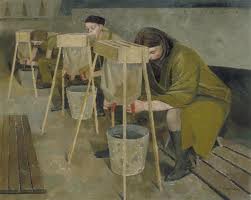
Milking Practice With Artificial Udders (1940)


Milking Practice with Artificial Udders (1940)


Evelyn Dunbar: Milking Practice with Artificial Udders 2' x 3' (61 x 76cm) Imperial War Museum, London


In the winter of 1939, several months after the failure of The Blue Gallery, Evelyn's art gallery above her sisters' shop in Rochester High Street, she heard from Sir William Rothenstein that the Ministry of Information was setting up a scheme for the employment of women artists to record wartime activities. Sir William Rothenstein, one the great names in British art in the first half of the 20th century, had been Principal of the Royal College of Art during Evelyn's 1929-33 studentship. He thought highly of Evelyn's work and remained as a sort of mentor and patron to her until his death in 1945. At his suggestion Evelyn applied, shortly after her 33rd birthday, to the War Artists' Advisory Committee (WAAC) for consideration as a war artist, specifying her preference for horticultural and agricultural subjects. The following April her appointment as an Official War Artist, answering to the WAAC, was gazetted in The Times. Her application coincided with some exterior pressure on the WAAC to recruit women artists, and Evelyn was one of the first three to be appointed, the others being Dorothy Coke and Ethel Gabain. She rarely looked back.

Her initial brief, from late April 1940 into the following May, was to record home front war-support activities undertaken by the Women's Voluntary Service and the Women's Institute. Three paintings were accepted by the WAAC from this period: firstly, and with some enthusiasm, Putting on Anti-Gas Protective Clothing and, although not submitted for several  months, A Knitting Party and A Canning Demonstration. Subsequently she was directed to the Sparsholt Farm Institute, near Winchester, a centre for the training of Women's Land Army recruits. Among the first batch of paintings submitted to the WAAC in September 1940 was Milking Practice with Artificial Udders.

Evelyn threw herself into this new work with huge energy and enthusiasm. She had been at a crossroads of depression before her appointment, what she called her 'crisis' years. Her separation from the artist Charles Mahoney, once her Royal College of Art tutor, in late 1937 had been painful, although they continued to correspond occasionally. The Blue Gallery hadn't been the success she hoped. Her work had seemed purposeless and without direction. She felt condemned to live at home and work behind the counter in her sisters' shop. Now a broad, bright highway beckoned her urgently. The work accorded well with her beliefs about the contract between Man and Nature and even allowed her to promote them, especially when the Women's Land Army was the subject. And, given Evelyn's enjoyment of the harmlessly bizarre, she would surely have been much tickled by the procedure she was about to record.

Milking Practice with Artificial Udders is a well-balanced composition that tells us much. The apparatus consists of a rickety wooden Heath Robinson frame, from which a canvas bag full of water is suspended. The bag is fitted with several red rubber teats. It's all of a piece with the sometimes quaint, amateurish and makeshift expedients, resources and contraptions that Britain was obliged to fall back on in the earlier days of World War 2. The painting dates from the early summer of 1940, and it gives a sense of context to remember that as Evelyn was recording these trainee dairymaids, whom one feels she has got to know quite well, Britain was in the midst of a terrible crisis: the inept Chamberlain government had fallen, Churchill had become Prime Minister and the remnants of the British and French armies were being evacuated from Dunkirk after severe defeat by Hitler's armies. (Indeed, Alec Dunbar, the younger of Evelyn's two brothers, was serving in the Royal Navy and commanded a minesweeper during the Dunkirk evacuation.)

Evelyn has turned the exercise into a competition, as much for the viewer as for the girls taking part, who are showing us the right way and the wrong way of milking. These girls are recent recruits to the Women's Land Army, probably in their late teens and with no experience of dairying or of working on the land. They're probably living away from home for the first time. There's a quiet, fixed determination about them, but later there will be a minor sense of triumph as one of them manages to fill her pail of 'milk' before the other two. Which one it is I leave the reader to work out while we look at another aspect of Evelyn's work.

While Evelyn was at Sparsholt, Michael Greenhill, who was responsible for the instruction of recruits, invited her to collaborate on a manual, a primer of farmwork. In due course A Book of Farmcraft appeared, with text by Greenhill and illustrations in pen and ink by Evelyn. Her preferred method was to complement Greenhill's text by showing the right and wrong ways of doing things - carrying sacks, harnessing horses, steering tractors and trailers through gateways - in paired illustrations. The book clearly fulfilled a deeply-felt need and eventually more than 40 000 copies were sold.

Evelyn Dunbar: illustration from A Book of Farmcraft (Longmans, London, 1941)

Her model for the 'right' and 'wrong' way of milking was a senior Sparsholt recruit called Anne Hall. Evelyn's drawing of the 'wrong' way showed Anne Hall deliberately bent double, her milking stool tipped up, her head well forward, arms fully extended and her milking pail - with off-centre aperture - held between her boots. The 'right' way showed her sitting with a less tiring, more upright posture, in such a position that she could, if necessary, rest her cheek against the cow's flank, an action which apparently encourages reluctant cows to give milk. 

Evelyn Dunbar: illustration from A Book of Farmcraft (Longmans, London,1941)
 
 
* * *

Milking Practice with Artificial Udders is one of the few war paintings of which we have the original sketch. This would have been pieced together - the background of the dairy wash-room with its duckboards, the artificial udder apparatus, the girls who volunteered to model - on site at Sparsholt. The sketch would then have been taken back to Evelyn's studio in Rochester to serve as the basis of the finished canvas.

Evelyn Dunbar: preliminary sketch for Milking Practice with Artificial Udders, 1940. Image by courtesy of Paul Liss of Liss Fine Art.
  

But that quiz...which of the three girls is going fill her pail first? Even allowing for individual styles of milking, it seems that the most distant Land Girl has put herself out of the running. As one whose life is the poorer for never having milked a cow, I hesitate to decide between the other two, but I suspect the Land Girl in the middle, who is not resting her elbows on her knees and whose stance is better placed to lay her cheek against the cow's flank if necessary, will fill her pail first. If she has not cheated, that is: José Loosemore, Assistant Dairy Instructor at Sparsholt, remembered that one such trainee Land Girl, dissatisfied with the flow of 'milk', had poked about in the hole of the teat, trying to enlarge it or unblock it with a Kirby grip taken from her hair. José Loosemore's robust response was 'For God's sake don't try to ram it up the real thing!'
 
 * * *
 

   Evelyn Dunbar: Land Girl Milking c.1940 c. 8" x 12" (20.3 x 30.5cm) Location unknown
  
There's a rather sad end to this otherwise cheerful and encouraging story. I don't know in what circumstances Evelyn's 'right' way was transformed into an engaging little oil study, apparently measuring 8" x 12" (20.3 x 30.5cm), which at one time was in the possession of Wye College, Kent, having been gifted by Evelyn' husband, Dr Roger Folley, many years after her death in 1960. I knew nothing of its existence until it was reported by the Kensington and Chelsea Gazette as having been stolen from an address in London in May, 2010. Oh dear.


(Text © Christopher Campbell-Howes 2019. All rights reserved)


Further reading...

     EVELYN DUNBAR : A LIFE IN PAINTING
         
         by Christopher Campbell-Howes

          is available to order online from:

         customerservices@scriptps.co.uk

       448 pages, 301 illustrations. RRP £30
 

Thursday, 7 June 2012

Gardeners' Choice (1937)


In November 1937 Routledge & Sons published Gardeners' Choice, written and illustrated by Evelyn Dunbar and Cyril (usually known as Charles) Mahoney, her former Royal College of Art tutor, fellow muralist, companion and lover. It was well received by the press, it ran to three impressions, each with a differently coloured dust jacket, and it was selected by the First Edition Club as one of the 50 best books of 1937. The title page above is that of a signed copy Evelyn gave to my mother in 1942, and which I still have.


In 1935, while she was working with Mahoney on the Brockley Murals, Evelyn was commissioned by Routledge to provide the dust jacket, the frontispiece and 25 vignettes for a dip-into miscellany called The Scots Weekend and Vade Mecum for Host, Guest and Wayfarer. Contact with Routledge led to Evelyn asking a commissioning editor called Ragg about the possibility of publishing, or at least illustrating, books about gardening or farming. Ragg concluded his reply by asking Evelyn if she knew of anyone who might be interested in writing a 'really new' book about gardening. She passed the news on to Mahoney, quoting Ragg:

 Extract from letter to Mahoney, June 1936. Tate Archive ©The estate of Evelyn Dunbar

While working at Brockley Evelyn and Mahoney had developed a close association, both professional and emotional. Evelyn saw her future as a continuing partnership with Mahoney. She was disappointed with Mahoney's departure (although long foreseen) from Brockley in May 1935, leaving her to complete the project alone, but she did not lose heart. After Brockley various collaborative propositions came their way, but Mahoney was not keen to tie himself down. The extensive collection of letters from Evelyn to Mahoney, covering the years 1933-37 and now housed in the Tate Archive, show Evelyn proposing a closer and ever closer association, with Mahoney (none of whose replies survives) apparently trying to assert a lost freedom and independence as it became clear that they were not really very well matched. Evelyn's Christian Science clashed with Mahoney's atheism, her bourgeois and merchant background sat uneasily with Mahoney's strong left-wing leanings, her natural playfulness and doctrine of perpetual cheerfulness compared ill with his volcanic temper provoked by opposition, together with a dictatorial tendency which Evelyn called his 'Caroline autocracy'.

What continued to unite them was a shared love of plants and gardening, and from this came Gardeners' Choice, their only post-Brockley collaborative venture that came to fruition. Evelyn hoped this apparently seamless collaboration would stand as a metaphor for the strength and permanence of their relationship, but by the time Gardeners' Choice appeared in late 1937 she and Mahoney had separated. A question mark hangs over who wrote or drew what. In a biographical note dated 11th February, 1990 intended to update and correct an earlier Tate Gallery catalogue (Modern British Paintings, Drawings and Sculpture), Evelyn's husband Roger Folley wrote '[...] E.D. also wrote most of Gardener's Choice'. The vignettes are all Evelyn's, as are the dust jacket and the end papers, while the 40 full-page pen-and-ink drawings were shared between them, Evelyn contributing at least 10.

The text shows an intimate knowledge of the chosen plants, some of which are quite uncommon and in some cases not far removed from what many conservative gardeners of the period might have regarded as weeds. Conventions of another age would find it hard to include many of them as suitable candidates for herbaceous borders. It is this unconventionality that gives Gardeners' Choice the 'really new' character that Ragg was looking for. Rarity, individuality and lowliness are seen as virtues. Of lupins, hollyhocks and delphiniums (except, typically, the dwarf Delphinium belladonna) there is no mention, their traditional place being taken by flowering onions, angelica, mulleins and periwinkles, to mention only four. No doubt the influence of that doughty and indefatigable gardener Florence Dunbar was strong. In preparing Gardeners' Choice Evelyn and Mahoney could draw on several years'-worth of intense plant-sharing experiences.

While many of the plants discussed may have been cultivated in the family garden in Rochester, there are records of Evelyn and Mahoney travelling together to the gardens at Kew and Wisley. For some contemporary artists, gardening and painting went hand in hand: Evelyn and Mahoney visited several artist friends' gardens in search of material, particularly the garden of Edward Bawden at Great Bardfield in Essex. Mahoney had no garden of his own at the time Gardeners' Choice was being written. On the occasion of one of Mahoney's visits to The Cedars, the Dunbar family home in Rochester, Evelyn sketched him drawing Bergenia crassifolia, which eventually appeared in Gardeners' Choice:
 
Charles Mahoney drawing Bergenia crassifolia in the garden at The Cedars, spring 1936. Photograph ©The author
 
Evelyn's vignettes are warm and lively, human and witty, and show something of the spirit of the Dunbar family garden. Here is her fashion-conscious older sister Marjorie, whose attitude to garden tasks seems ambivalent, although anyone who has wrestled with a push-mower will have every sympathy and will not deny her a snooze in the deck-chair:


And we don't know how much of the daily toil was undertaken by the two gardeners employed by the Dunbar family, Alf and Bert (it's not certain which was which), or by the outdoor staff employed by Evelyn's aunt (Florence Dunbar's sister) and uncle, Clara and Stead Cowling, who lived in some style at Steellands, Ticehurst, Sussex, and whose house and garden sometimes appear in Gardeners' Choice. Particularly Evelynish is the short and stocky figure below returning from his allotment with a bundle on his back, maybe greenstuff for rabbits, and a bunch of flowers for Mrs Alf/Bert:


Florence Dunbar and her sister Clara Cowling appear several times in these drawings, clearly as hands-on gardeners and driving forces:


It is a measure of the influence Edward Bawden and his Great Bardfield garden had on the evolution of Gardeners' Choice that Mahoney and Evelyn asked him to write the Foreword. He did so, sending a handwritten draft to Mahoney in September 1937, accompanied by a letter asking for amendments and corrections. It could hardly have arrived at a worse moment: Evelyn's and Mahoney's relationship had reached breaking point. Bawden seems to have been told, however, that he was too late, that Routledge's deadline had passed, and so it was never published. Bawden's draft Foreword eventually appeared some 80 years later in a Persephone Books 2016 reprint of Gardeners' Choice.

* * *

One of the less common 40 herbaceous perennials featured in Gardeners' Choice was Bocconia cordata, or Plume Poppy. For some reason Paolo Boccone has been usurped by Alexander Macleay, so Macleayia cordata is now the correct botanical name.


Extract from Gardeners' Choice, Routledge, London 1937. Text: Evelyn Dunbar and Charles Mahoney. Drawing: Evelyn Dunbar


There was, while we lived there, a relic of Gardeners' Choice in our garden in the south of France, living on in a way which I hope would have pleased both Evelyn and Mahoney. The original stand of Bocconia cordata - it grows a strong central root, propagating itself energetically from outspreading runner roots - came from the garden at The Cedars, which the remaining Dunbars sold in 1946. Evelyn and her husband Roger Folley planted a stand at The Elms, the house near Ashford, Kent, to which they moved in 1951. The same original stock, divided and subdivided, has appeared in almost every garden of our family since. Here is our descendant, probably 80 years after its ancestor left The Cedars:

Bocconia cordata (otherwise Macleayia cordata) in the author's garden, with (L) Felis catus (otherwise Pinot).


(Text © Christopher Campbell-Howes 2019. All rights reserved.)

 
Further reading...

EVELYN DUNBAR : A LIFE IN PAINTING
       
      by Christopher Campbell-Howes

       is available to order online from:

     customerservices@scriptps.co.uk

   448 pages, 301 illustrations. RRP £30


Monday, 7 May 2012

Winter Garden (1928-1937)

Evelyn Dunbar, Winter Garden
Evelyn Dunbar Winter Garden ?1928-1937 (1' x 3': 30 x 91cm) Tate Britain 


Evelyn was in her early twenties and about to enter the Royal College of Art when she began this painting, in about 1928. It isn't very large: it measures 1' by 3', about 30 x 90cm. She called it Winter Garden, and it's now in Tate Britain, although not permanently on display.

In 1928 she was living with her family in Strood, which is that part of Rochester, Kent, on the west bank of the river Medway. She and her parents William and Florence Dunbar and her four older siblings, Ronald, Jessie, Marjorie and Alec lived in a house called The Cedars, a large Victorian house built in 1865 on the site of a demolished stock mill. From The Cedars there were - alas, no longer! - distant views across the valley to Rochester with its prominent Norman castle and cathedral. From an early age Evelyn had shown considerable artistic talent, and the promise she showed was recognised in the 1929 award by Kent County Council of an exhibition to the Royal College of Art, increased to a full scholarship the following year.

The Cedars had an extensive garden, now built over. Evelyn drew on this garden for ideas for many years. Winter Garden shows it from the end farthest from the house, which we can see in the right hand background. The eye is led to it, following the gravelled and neatly-edged garden paths. The pyramid-shaped structure at the top of the house is the studio, shared by Evelyn with her mother, an amateur artist who specialised in floral still-lifes.

The Dunbars employed two gardeners, Alf and Bert. One, inherited by William Dunbar when he bought the property in 1924, was short and stocky. The other was younger, tall and rangy. We don't know which was Alf and which was Bert. Here is a little caricature Evelyn made of them, but we're no nearer identifying which was which:

 Letter to Charles Mahoney, 20th October 1936. Tate Archive, ©The estate of Evelyn Dunbar

Thanks to them and no doubt members of the family, everything, even in midwinter, is tidy, controlled, expectant and ready for spring growth. Hedges are neatly clipped, the lawn has received its last cut of the old year. The apple and pear trees espaliered along the right-hand brick wall have been pruned. The end of the year is waiting for the beginning of the new one. It's an image of promise. Guarantee, even. The year will turn, new life and new growth will start as spring approaches and the days lengthen. 'In my end is my beginning.' It will become the major theme in Evelyn's work. It's surprising to find it in her very first significant painting.

There's a subtle light of great beauty over the whole scene, rich in its interplay of harmonies. Its muted colours perfectly evoke a calm, quiet and windless December or January day in the south of England. I wonder what clues tell me it's afternoon, that evening isn't far off? I can't identify them, but it's the feeling I get.

It took Evelyn the best part of 10 years to finish this painting. She finished it in 1937, ready for exhibition in London the next year. The gestation can perhaps be explained by the comparative rarity of days like this in Kent, by Evelyn's absence in London for much of the period, by work having to be suspended as long as there were leaves on the trees, but I think there's maybe another reason. It's a very finished canvas, and its composition is extraordinarily complex, yet it appears effortless.

There are maybe five other paintings from Evelyn's hand that show the same meticulous and devoted care in construction and finish, and all of them took her a very long time to complete. And I think she was reluctant to let this painting go, maybe because Winter Garden is a metaphor, an ikon for all that she was beginning to believe, partly through the open window of Christian Science, about Nature and Mankind: Man is utterly dependent on Nature, and Nature will completely fill Mankind's needs, provided - and what a big proviso! - Mankind returns Nature's unending bounty with love, respect and intelligent husbandry.


* * *


The Dunbar family home, The Cedars, in 2013. Author's photograph
 
Today all this has gone. The Cedars is still there, recognisable by the pyramid-capped tower. About 40 crowded houses now cover what was once this magnificent garden.

(Text © Christopher Campbell-Howes 2019. All rights reserved.)

 
Further reading...
 
    EVELYN DUNBAR : A LIFE IN PAINTING
            
             by Christopher Campbell-Howes
 
              is available to order online from
 
               customerservice@scriptps.co.uk
 
              448 pages, 302 illustrations. £30