Saturday, 30 March 2024

A Knitting Party (1940)


A Knitting Party 1940 Oil on canvas (18¾ x 19¾ in: 45.7 x 50.8 cm) Imperial War Museum, London

A Knitting Party is one of the earliest of Evelyn's war paintings.

On April 17th 1940, four months after her application to the War Artist's Advisory Committee, Evelyn was gazetted as an official war artist. It was a particularly important event for her, perhaps the defining moment in her career; for over a year previously she had been working in some desperation behind the counter of the children's wear shop run by her older sisters Jessie and Marjorie in Rochester High Street. Evelyn and her fellow artists Dorothy Coke and Ethel Gabain were the first women to be appointed. For Evelyn her appointment heralded the end of what she called her 'crisis' years, 1938-40, years of sterility, lack of purpose, family bickering and personal poverty.

Although in her application Evelyn had requested to be assigned to agricultural or horticultural subjects, she was initially asked to record women's activities on the home front, particularly those of the Women's Voluntary Service. In her acceptance letter to Edward Dickey, secretary of the War Artists' Advisory Committee, Evelyn wrote that she had no money and was therefore unable to travel anywhere, nor to buy materials, adding a little later that '...there are certain subjects which may be available at home'. She contracted to produce 6 WVS-based pictures for a fee of £50, some £4,000 at today's values. In the event only 3 were produced as Evelyn's initial contract was amended to include wider subject areas. In due course Dickey produced travel warrants and arrangements for her to indent for artist's materials. 

One of the subjects 'which may be available at home' was A Knitting Party. It was planned, sketched and started in the earliest days of Evelyn's contract. It is best interpreted and understood in the context of the momentous events, of the war overseas and the politics at home which shook Britain violently in the spring and early summer of 1940. Its gravity might be best expressed in the form of a timetable:

April 17th, 1940: Winston Churchill, as First Lord of the Admiralty, is heavily involved in the war in Norway, which is not going well despite some local successes. The Nazi Norwegian campaign, fought to secure supplies of iron ore, is marked by both tactical and terror bombing. British and allied troops are finally evacuated by June 9th.

May 7th-9th, 1940: Failure to expel the Germans from Norway leads to the Norway Debate in parliament. The Conservative Prime Minister, Neville Chamberlain, resigns amid calls for a National Government.

May 10th, 1940: Nazi forces overrun Holland, Belgium and Luxembourg within 24 hours. Invasion of France follows soon after. Churchill becomes Prime Minister.

May 13th, 1940: In his first parliamentary speech as Prime Minister, Churchill says he can promise nothing more than 'blood, toil, tears and sweat'. British, French and allied troops retreat in disorder before the German onslaught, abandoning large amounts of matériel, culminating in the evacuation of remaining troops from the beaches at Dunkirk from 26th May to June 4th, 1940.

* * *

Enter Lady Stella Reading, one of several largely unsung heroines of 20th century Britain. An extraordinarily astute and energetic woman, she was among those few Britons who recognised that the clouds of war with Hitler's Germany were fast gathering on the horizon, and that such a war would feature urban and civilian bombing in an unprecedentedly horrific way, as exemplified by the Nazi Condor Legion, fighting on General Franco's behalf in the Spanish Civil War (1936-39), and in the barbarity of Mussolini's East African colonial wars (1935-37). Lady Reading had the ear of Sir Samuel Hoare, the British Home Secretary; she proposed the creation of a civilian women's service, to be called the Women's Voluntary Service for Air Raid Precaution Service, in the event abbreviated to WVS. The WVS was to provide hands-on back-up to the emergency services, particularly as regarded evacuation from cities liable to bombing. It was to have no ranks, apart from local organisers. Between its inauguration in 1938 and the creation of A Knitting Party in April 1940, thousands of women had joined the organisation and its scope had widened very considerably.

The extent of this widening of WVS activities can be judged from a unique wall poster created by a Mrs Pennyfeather, local organiser in Walton and Weybridge, in Surrey, who designed and created a 'Spider's Web' to show all the activities of her WVS branch. (Time has faded the text and colours, but it's mostly decipherable with patience.)
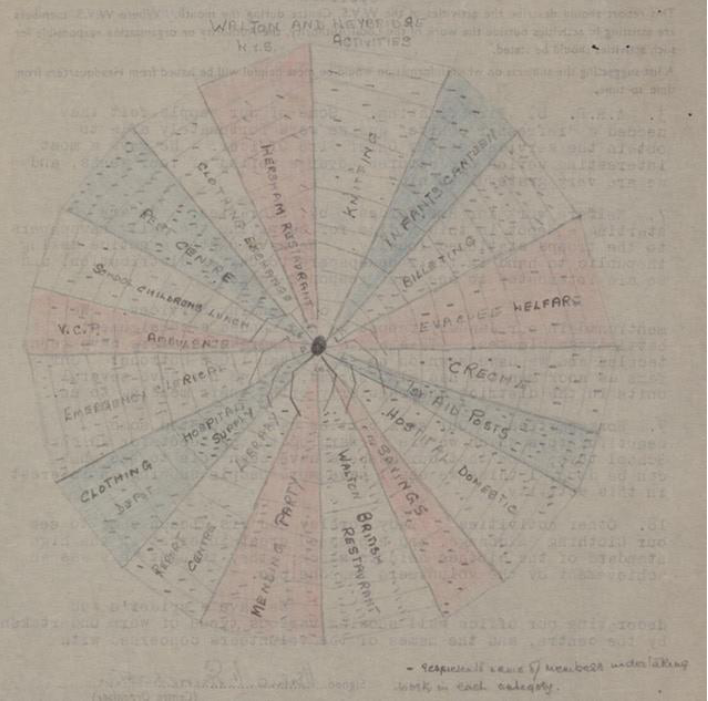
  
Mrs Pennyfeather's 'Spider's Web' reproduced by kind permission of Heritage, Royal Voluntary Society, to whom many thanks

Reading clockwise from the top, we have firstly - as is fitting for this essay - Knitting; Infants' Canteen; Billeting; Evacuee Welfare; Creche; 1st Aid Posts; Hospital Domestic; Savings; Walton British Restaurants*; Mending Party; ? Centre Library; Clothing Depot Hospital Supply; Emergency Clerical; V.C.P. Ambulance; School Children's Lunch; Rest Centre; Clothing Exchange; Hersham Restaurant.

* 'British Restaurant' was a term happily invented by Winston Churchill to replace 'Community Feeding Centres'.

* * *

The Dunbars were a close family, especially after the death of Evelyn's father William Dunbar in 1932. 'They lived within themselves', Evelyn's husband Dr Roger Folley said of them later. In 1940 they all lived at The Cedars, a large house in Strood, the left bank suburb of Rochester, Kent, with the exception of Alec Dunbar, fourth of the five siblings, who had married and lived nearby. Alec was serving with the Royal Navy; within a few weeks of his sister starting A Knitting Party he would be present at Dunkirk helping evacuate British and French troops in a Royal Navy minesweeper, a vessel converted from a herring drifter.

The Dunbars were not particularly sociable. Alec and Evelyn were by far the most outgoing. Further, the Dunbars were practising Christian Scientists, and felt themselves a little removed from the general populace; not in any way superior, just different. The two older daughters, Jessie and Marjorie, had disfigurements - Jessie with a wall eye, Marjorie with a lupus which gradually spread down her face and neck - which turned them to each other for support and discouraged them from appearing in public. The Cedars was not a house which welcomed many visitors.

A probable scenario for A Knitting Party is that Florence Dunbar, the siblings' mother, received a request from Mrs King, the Rochester WVS centre organiser and a local bank manager's wife, to make The Cedars available for groups of knitters. It's possible that the knitters, not always the same women, had been coming to The Cedars on several occasions before April 17th, 1940, the date of Evelyn's appointment. Evelyn, no doubt as a further spur to her enthusiasm to get started, discovered that here was a subject ready-made for her brush, requiring no more travel than to leave her studio in the tower of The Cedars and run downstairs, drawn mainly by the click and clack of knitting needles because, as Evelyn shows them, mouths are tight shut; no one is talking in the sitting room below. (As of 2024 The Cedars is still there, with its pyramid-roofed tower, although closely surrounded, indeed crowded, by other more recent housing.)

That Evelyn had a problem with her mise en scène is suggested by the quantity and variety of pencil sketches that survive. Several appeared in 2013, having spent the 53 years since her death in 1960 tucked away in portfolios in the attic of Hammer Mill Oast, near Biddenden in mid-Kent. More, including the sketches below, followed with the additional recovery of some 20 sketchbooks from Hammer Mill sheds and outhouses in the Covid years. The Hammer Mill discoveries, together totalling some 800 drawings, sketches, studies and finished canvases caused ripples of astonished delight in the art world. In fact - the story is well established - after Evelyn's death her husband Roger Folley assembled almost all the residual work in her studio and consigned it to Alec Dunbar, the only sibling with room to accommodate it. The oast house sketches were in remarkably good condition, testament to the incidental suitability of oast houses, with their continuous updraughts, for the preservation of art works; those from nearby sheds required extensive restoration work. In due course the sketchbooks were acquired by the Special Collections facility of Oxford Brookes University devoted to Evelyn's work. 

The figures in the sketches below are too heterogeneous for them to be portraits; none of them, apart from the two women facing the artist in the bay window, is identifiable, for reasons suggested below. The Cedars sitting room was too small to accommodate in a portrayable fashion these fifteen knitters and a child, or at least a very small person, almost hidden behind the pile of blankets on the tripod table in the middle of the room. How to make the room appear larger, how to distribute the knitters about the room, while making their distribution an integral feature of the design? How should she concentrate attention on the most distant person, the seated woman in the window bay? In a sense A Knitting Party is about this person: she is Florence Dunbar, of whom more in a moment. 

We can gauge Evelyn's problem by looking at three of her preliminary sketches.


A Knitting Party 1940 Preliminary sketch 1 Pencil  Oxford Brookes University, Special Collections, Headington, Oxford 

This early sketch shows Evelyn feeling her way. A simple oval doing duty for the central tripod table has squiggles on it marked 'wool'. Later versions - see below - have this central table laden with folded blankets, to be understood perhaps for the moment as the group's output. An ingenious but ultimately pointless touch is to augment the number of knitters by showing some of them reflected in the mantelpiece mirror. It doesn't really work; what it shows us is Evelyn's readiness to manipulate the spacing of the group, and in doing so to present the viewer with a fiction, an as-it-might-have-been rather than an as-it-was. We might note in passing that the mantelpiece clock has no hands.


A Knitting Party 1940 Preliminary sketch 2 Pencil Oxford Brookes University, Special Collections, Headington, Oxford

In sketch 2 Evelyn has managed to squeeze ten people in, reasonably distributed round the room and in the window bay. The tripod table, with its heap of blankets, is central to the composition, but to pile them higher would obscure Florence Dunbar, the person sitting in the middle of the window bay. Without her the picture will have very little meaning. (We are also allowed a glimpse of a very necessary period piece: the sock-knitter's hat pin, lower right.)

                    
A Knitting Party 1940 Preliminary sketch 3 Pencil Oxford Brookes University: Special Collections, Headington, Oxford

Now we're on the way. We have our group of knitters, including the very small person half-hidden by the pile of blankets, but Florence is missing. In her finished version Evelyn makes room for her mother by turning the entire scene clockwise by several degrees.                


A Knitting Party again, for ease of reference

In the event, she has simply invented some space on the right of the finished picture. The wall with the fireplace is like a stage flat, with nothing behind it. This has enabled her to open out the window bay, allowing extra light in with the added perspective depth, complemented by the pattern in the carpet, drawing attention to the two most distant figures. Both these are hatless, Florence, sitting in the captain's chair, because she is in her own home, and the standing figure next to her because she is family: she is Vera Swain, Florence's niece, Evelyn's cousin. This is very curious, because at the time Evelyn was painting A Knitting Party, in April and May 1940, Vera Swain was in Sri Lanka, then called Ceylon, with her husband Val.

What the women are knitting is uncertain. Socks, scarves, balaclavas? Maybe the campaign in Norway isn't far away. There are piles of completed work on the floor. The central table is piled with blankets, or possibly comforters, so high as to obscure, for an unfathomable reason, the child or very small person behind them. It may be that Evelyn has added them as a reference to their destination: the colours are deliberate, navy blue, khaki for the army, light blue for the Royal Air Force. The military colours are echoed by the décor, the upholstery and to some extent by the knitters' clothes in an unspoken solidarity with the armed services.

* * *

But what about this?


A Knitting Party 1940 Preliminary sketch 4 Oxford Brookes University: Special Collections, Headington, Oxford


A Knitting Party (detail): Florence Dunbar looks at her watch.

Almost invariably in Evelyn's war paintings - and elsewhere, of course - there is some tiny detail that is the key to an alternative, and maybe more important, agenda to the scene. The sketch suggests that Florence's posture and activity is absolutely deliberate, even exaggerated to make the point: she has taken her eyes off the ball of wool she is winding from the hank of navy blue wool (for her son Alec, at sea?) which she is holding between her knees in order to look at her watch. It's this kind of detail that can transform an otherwise fairly banal account of something at first view not terribly extraordinary into something with another agenda, another layer of meaning. 

In A Knitting Party context is all. However chattery, lively and laughter-loving the knitters may have been before the crisis of mid-April 1940, the dire threats from across the Channel have given them much to think about. Never had Britain been so threatened; the sense of imminent danger is palpable. Later they might relax, joke, evoke the spirit of undaunted Britishness, a few weeks later to be eternised as the Dunkirk spirit. Later they might sing There'll be blue birds over The white cliffs of Dover or Run, Adolf, run, Adolf, run, run, run or even (acknowledging the nationwide American presence) Pistol Packin' Mama but just now, at this moment, things are grim indeed. I suggest that one of Evelyn's problems is how to express this without, however subconsciously, calling to mind the Fates of classical literature, or - a little nearer home - Madame Defarge and her circle of knitters beside the tumbling, bloodied blade of the French Revolutionary guillotine from Dickens' A Tale of Two Cities.

In pointedly looking at her watch Florence may well have been wondering when this sombre, silent crew of knitters would go home, but there are other possibilities. Was she checking the time for the next BBC Home Service news bulletin, read by the instantly recognisable Alvar Liddell, with perhaps yet more dire news? Was she wondering, symbolically, when all this dreadful experience would be over? Or has Evelyn charged her with wondering, figuratively, how long it would be before the social and economic credits even then being earned with each knit and purl by these women, individually unidentified because collectively they represent their entire sex, would come to pass?

Florence Dunbar would not be able to see the mantelpiece clock from where she is sitting, but in fact Evelyn has left the dial indistinct, with no suggestion of hands or of time being expressed: it is nothing o'clock. Is this deliberate? Curiously, the apparently insignificant detail mentioned earlier, the pointer to other, maybe deeper levels of meaning in certain of Evelyn's paintings, is found tucked well away from the main action, in this case towards the top right hand corner. (There's another example of it in Singling Turnips (1943), where a labour squad of Italian prisoners of war is hoeing.)

I advance the following theory with great trepidation. Evelyn's Christian Science led her to a deep knowledge of and trust in certain books of the Bible, notably the first and last, Genesis and Revelation, with the Psalms, Job and the Gospels coming in between. A continuing trope throughout her mature work concerns concepts of time, in my end is my beginning (St John 20-21, although very obscurely) and especially there shall be time no longer (Revelation 10:6). This is usually taken to mean, basically, that the duration of present evil is limited; Evelyn's meaning, surely shared with her mother, who is looking to see if the hour has come, is that the dreadful happenings of April-May 1940 will not go on for ever.

* * *  

A footnote, read into it what you will: Val Swain, Vera's husband, had business interests in the Far East, specifically Sri Lanka, then known as Ceylon. The Swains came back to Britain on leave in the summer of 1940. (There were still some civilian sailings.) Evelyn's and Vera's aunt, Clara Cowling, who lived at Ticehurst, near Tunbridge Wells, in a large house called Steellands, now renamed Apsley Court, kept a diary throughout the war years. (These diaries, covering 1940-46 although 1942 is missing, are now housed at The Garden Museum, Lambeth Palace Rd, London.)

The Swains stayed with Clara Cowling for some three weeks in July and August, 1940. On Wednesday, 7th August Clara Cowling wrote in her diary:

Went to Strood quarter to 10. Had a nice day with them all at home. Looked at Eves pictures & Florries all very nice. Home about 7-15. We are all so glad we met.

The Swains left Steellands shortly afterwards and returned to Sri Lanka while civilian sailings were still possible. Val Swain, at least, did not return until the end of the war in the Far East. 

A little plot thickens. Evelyn started A Knitting Party probably in the second half of April 1940. Completion was interrupted by her posting by the War Artists' Advisory Committee to Marlow, in Buckinghamshire, to record Civil Defence activities, which resulted in Putting on Anti-Gas Protective Clothing. She put it aside again in May-June when the main thrust of her Sparsholt Farm Institute paintings started to preoccupy her. She did not pick it up again until the following autumn, when her Sparsholt portfolio was approaching completion. The only occasion, in the war years, on which Vera Swain is known to have been present at The Cedars, and in Evelyn's studio (shared with her mother 'Florrie'), was on 7th August, as recorded by her aunt Clara. I'm tempted to believe that Vera Swain was not present at any stage of the composition of A Knitting Party, and that Evelyn added her cousin, shown folding a completed blanket or comforter, sometime after August 7th, as a compliment to someone of whom she was fond but saw very rarely. And of course by which time the immediate danger had receded to some extent, allowing Evelyn to obtrude a personal touch that would have been unthinkably foolish some months before, in her initial work for the War Artists' Advisory Committee and the start of a new career. 
 
Warmest thanks to Emeritus Professor James Hinton for his help, to Tom Dobson for his restoration work on the Dunbar sketchbooks, and to Claire Brenard (Curator of World War 2 Art, Imperial War Museum) for their contributions; also to Victoria Northwood, Archive & Heritage Consultant, Royal Voluntary Service Archive & Heritage Collection for permission to include Mrs Pennefeather's 'Spider's Web' in this essay.
 
Text ©Christopher Campbell-Howes 2025. All rights reserved.
 
 
Further reading...

          EVELYN DUNBAR : A LIFE IN PAINTING
  
                 by Christopher Campbell-Howes

                 is available to order online from:

               customerservices@scriptps.co.uk

              448 pages, 301 illustrations. RRP £30


Saturday, 17 February 2024

Joseph in Prison (1949-50)

Joseph in Prison 1949-50 Oil on canvas 46 x 36cm (18" x 14") Photograph reproduced by kind permission of Woolley and Wallis

It's always a very special moment when a long-lost painting of Evelyn's appears out of the blue. The moment becomes more special when the painting in question is one of a set or group, and the event takes on a yet greater significance when the painting hasn't been seen publicly for the best part of 70 years.

Evelyn, a committed Christian Scientist, knew parts of the Bible well, especially the Old Testament. Genesis, the first book of the Old Testament, consists largely of narratives, some would say foundation legends, rich in truths if not in truth, of the origins of the Jewish people. Indeed, Joseph's father Jacob had the alternative name Israel, indicating fatherhood of his people.

Joseph had a particular appeal to Evelyn. Last-born but one, he was his father's favourite, to the annoyance of his many brothers. He's probably best known for his famous coat of many colours, a present from his father, a gift translated into popular 20th century musical idiom by Tim Rice and Andrew Lloyd Webber as his Joseph and the Amazing Technicolor Dreamcoat. Joseph had a propensity for the interpretation of dreams. Two youthful dreams suggested his superiority over the rest of his family, something hardly likely to endear him to his siblings.

There were echoes of this to some extent in Evelyn's family situation. At certain times in her career she felt something of a cuckoo in the nest of a family of Kentish shopkeepers. (She refers to herself as such in her 1937/38 allegory April.) Kindly and welcoming people though her Dunbar siblings were, they sometimes found it difficult to come to terms with an artist sister who, despite several years of professional training, earned next to nothing, received very few commissions, lived at home and subsisted on handouts from her father's and her wealthy uncle Stead Cowling's estates. Her mother Florence, an amateur artist, defended her stoutly at home, and it may well be that Evelyn felt her own situation just as sharply as her siblings. Indeed, Evelyn later referred to 1937/40 as her crisis years.
 
Towards the end of 1937 she separated from Charles Mahoney, her former Royal College of Art tutor and later colleague and lover. A miscarriage deepened her depression and her future as an artist looked very bleak indeed. It was at this time that the idea of a series of paintings illustrative of the career of Joseph came into her head.


Joseph's Dream 1938-43 Oil on canvas 46 x 76cm (18" x 30") Photograph: Cambridgeshire County Council. Private collection

The first of what eventually became a trilogy was Joseph's Dream, a diptych or two-panel painting showing the adolescent Joseph in some perplexity confronted by his twin dreams of his brothers and parents bowing in homage before him, firstly in the form of sheaves of corn and then as the sun, moon and stars. Joseph's Dream was unfinished at the outbreak of World War 2 in 1939, by which time Evelyn had all but forsaken painting and was working behind the counter in her sisters' haberdashery shop on Rochester High Street.

Everything changed for her in 1940. Through the intercession of friends in the art world, particularly Sir William Rothenstein, she was gazetted as an official war artist. Then, during an early posting to paint trainee Land Girls at Sparsholt Farm Institute, near Winchester, she met Roger Folley, formerly an agricultural economist but at that time an RAF officer. They married two years later. With Roger's encouragement and - by his own account - help in modelling Joseph's figure but not his face, Evelyn completed Joseph's Dream in time for exhibition with the New English Art Club in 1943, where it attracted a favourable press reception but remained unsold.

After the war Evelyn and Roger settled down to their first taste of extended married life, firstly in Warwickshire and later in Oxfordshire when Roger obtained a post at Oxford University Agricultural Research Institute. So began the most productive and inventive period of Evelyn's career. Away from her family (Florence had died in 1944) the tensions that underlay Joseph's Dream disappeared, giving place to wider and maybe nobler visions of reconciliation, among them the conviction, given the biblical Joseph's later history, that one day she would be worthy of them.

In the Genesis story, Joseph's brothers had been extraordinarily hostile to him and would have murdered him if Reuben, the eldest brother, had not intervened. He proposed instead that they should rob Joseph of his many-coloured coat, smear it with goat's blood to suggest to their father Jacob that he had been killed by a wild beast. The brothers would then push Joseph into a deep pit, where he would certainly die. I hasten to add that this is not in any way to imply, of course, that the Dunbar siblings harboured murderous designs on their youngest sister.

Where did the image of Joseph's pit come from? One of the more unexpected of Evelyn's pastimes was rock-climbing, something she learnt from Roger, himself an experienced cragsman and fell-walker. One of their many rucksack-and-climbing-boot expeditions took them to Gordale Scar, a deep and forbidding ravine near Malham in North Yorkshire. The immediate visionary trigger that fused Joseph's pit with Gordale Scar isn't known, but the result was Joseph in the Pit, painted in 1947.

 Joseph in the Pit 1947 Oil on canvas 46 x 26cm (18" x 10") Photograph Petra van der Wal ©Christopher Campbell-Howes Private collection

Back to Genesis: in fact Joseph survived. Some of his brothers hauled him out and sold him to a band of passing nomads, who took him to Egypt, where they sold him as a slave. He was bought by Pharaoh's captain of the guard, a man called Potiphar. Attracted by Joseph's manly bearing, Potiphar's wife attempted to seduce him. When Joseph refused her advances, her lust turned to anger. She accused him of attempted rape and Joseph was thrown into prison.

So the third of Evelyn's Joseph trilogy is Joseph in Prison. Joseph has proved himself an able and trustworthy man to the prison governor, who gives him certain responsibilities. Among them is care of his fellow-prisoners, who include two of Pharaoh's close servants, his chief butler and chief baker. We aren't told why they were in prison, simply that Pharaoh was 'wroth' against them.


(Image as above, reproduced for ease of reference)

Sharing the same cell, each had a disturbing dream. The Genesis account goes on (Chapter 40, verse 6) 'And Joseph came into them in the morning, and looked upon them, and, behold, they were sad'. Here we are plunged into the actuality of Evelyn's Joseph in Prison. Joseph, the central figure in red, has opened the cell from the outside - evidence of his trustworthiness - to give breakfast of sheep's milk or something similar to the two inmates. Through the window dawn is breaking. Joseph, seen from above and in quarter profile, has a strong resemblance to Roger Folley. What is happening?

Later they recount their dreams. Joseph interprets them: for the butler it means release and a return to his former royal duties, but for the baker it means death. And so it turns out. Eventually Joseph's dream-prowess reaches Pharaoh's ears: he too has had a dream, which Joseph interprets as meaning that seven years of plenty would be followed by seven years of bad harvests and famine. And so it comes to pass. Joseph becomes Pharoah's right hand man, in charge of agricultural management and the storage of corn in years of plenty and of its distribution in time of famine. The predicted famine is universal. The now aged Jacob and his sons come from their land of Canaan to find corn. They apply to Joseph: they do not recognise him in his Pharaonic grandeur, even less - perhaps hardly surprisingly - from his new name, Zaphnath-Paaneah, supposedly meaning 'the god speaks: man lives'. (He is known as Aziz in the Koranic version of this story.) But Joseph recognises them, and after some vetting he allows them corn in plenty. He has become the provider for his people, reconciliation is complete, and maybe Evelyn has proved herself worthy of her family.


A strong and constant thread running through Evelyn's work is the contract, or covenant, or promise, that the Creator will provide the means for mankind to survive and flourish in exchange for mankind's undertaking to look after creation with intelligence, industry and love. The notion is most simply expressed in the early Genesis creation legend of the Garden of Eden, given to Adam and Eve 'to dress it and keep it'. When Evelyn was painting Joseph in Prison, Roger - in any case a keen gardener - was working at the Oxford University Agricultural Research Institute. In 1950 he was appointed to the Economics Department of Imperial College, London, at its agricultural campus in Wye, Kent, where he became a leading horticultural economist with a worldwide reputation in certain areas.
 
Would it be over-fanciful for Evelyn to equate, compare or identify Roger with the biblical Joseph? It's true that in other images (e.g. Autumn and the Poet)  Evelyn has vested him with the mantle of one who, through his intellectual work, kept his side of the Creator's bargain and its promise of provision. In 2023 a sketch turned up from the Hammer Mill Oast collection, the vast quantity of sketches, studies, juvenilia and unsold or minor work stored in her studio at her death and covering her entire career.
 
Sketch for Joseph in Prison 1949 Pencil Photograph ©Liss Llewellyn Private collection
 
Here Joseph's head is scumbled as though with a not-very-clean eraser or even a damp finger, while a little to the right two heads in profile appear. Both are of Roger, the upper more worked than the lower, exactly of the scale and direction of look were it to replace the head of Joseph. (An orphan female face appears in the lower right-hand corner, through a quasi-spider's web of scribbling. I don't think it can have any connection with the ongoing business. It was just Evelyn's habit to allow herself to be sidetracked in her sketches.)

Joseph in Prison was exhibited in Oxford in 1949 or 1950, where it was sold to Lionel Herbert, a prominent Oxford solicitor. Lionel Herbert lent it back to Evelyn for her solo exhibition at Wye in 1953, since when it has not been seen in public. For me it is privilege to be in a position to show for the first time since 1953 all three paintings in Evelyn's Joseph trilogy.


Text ©Christopher Campbell-Howes 2024

Further reading...

      EVELYN DUNBAR : A LIFE IN PAINTING
 
              by Christopher Campbell-Howes

               is available to order online from:
            
              customerservices@scriptps.co.uk

          448 pages, 301 illustrations. RRP £30


Tuesday, 30 January 2024

Pea Pickers at Ripper's Cross (1951)

 Pea Pickers at Ripper's Cross c.1951 oil on canvas 14 x 18in (35.3 x 45.5cm). Imperial War Museum

In 1950 Evelyn's husband, Dr Roger Folley, who since the end of World War 2 had been working for Oxford University Agricultural Research Institute, took up a new and more rewarding post at Wye College, in east Kent. (Wye College, now closed, was the centre of the agricultural economics campus of Imperial College, London.) While the move meant new professional horizons for Roger, for Evelyn it meant abandoning the many colleagues and friends she had at Oxford, chiefly centred on the Ruskin School of Art, where she had been teaching.

Apart from formal lectures and seminars, Roger Folley's Wye College work included visiting local farms, establishing a rapport with them, arranging and overseeing student placements and generally working in tandem with these farms to maximise efficiency and productivity. One such farm was Ripper's Cross, close to the village of Hothfield, west of Ashford, where the farm manager was called Allender. In due course the two couples, Folley and Allender, met: Evelyn and Marcella Allender took to each other at once, both quickly forming part of a circle of close friends.

With Pea Pickers at Ripper's Cross it seems that Evelyn has reverted to her wartime Women's Land Army images, but resemblance is superficial and if the Imperial War Museum accepted the gift (from a Mr David Bunker, a frequent visitor to the Allenders) in 1992 of Pea Pickers at Ripper's Cross it was not because of any community with its existing group of Dunbars. In fact it has no connection with her wartime painting; Evelyn's employment by the War Artists' Advisory Committee ceased in 1945, six years previously.

It's a spontaneous work, as cheerful and glad-hearted as ever, as though Evelyn had driven the few miles from The Elms to Hothfield to call on Marcella Allender, with whom she had gone for a walk down the Bethersden road. Was she struck by the unexpected flecks and flashes of colour of a gang of pea-pickers, themselves like a sudden patch of wild flowers?

No time, then, to do more than briefly record the overall scene in her sketchbook, or possibly on the back of a bill or an envelope: the geometry of the fields, the stately procession of cumulus humilis clouds, some midfield oaks, outliers of the remnants of the ancient Wealden forest stretching to the western horizon; no time to do more than hint at the bulbous shapes in the foreground so that we can't be certain what they represent, other than reminding us that nature's gifts rarely come in forms that are pinched or skeletal. By contrast the human figures, which I imagine Evelyn putting in on her return from Hothfield, are carefully drawn, their postures and attitudes convincingly recorded as they bend among the notoriously straggly and tangled pea-vines to snap off the pods and put them into sacks.

Did Evelyn consider this painting finished? Her general principle was not to sign anything unless it was finished. There's no signature here. Perhaps it doesn't matter. Pea Pickers at Ripper's Cross says enough to us about the Weald, about harmonies of green, about the closeness of mankind to the soil, about the eternal year-round organic whole. And maybe about peace after conflict, which is perhaps why the Imperial War Museum accepted it.

* * *

Thanks to Mr Colin, one time resident of Ripper's Cross Farm, for his contribution.


Text ©Christopher Campbell-Howes 2024. All rights reserved.


Further reading...

    EVELYN DUNBAR : A LIFE IN PAINTING
 
            by Christopher Campbell-Howes

             is available to order online from:


         448 pages, 301 illustrations. RRP £30


Saturday, 1 April 2023

Joseph in the Pit (1947)

 Joseph in the Pit (1947)


Joseph in the Pit Oil on canvas 1947 Photograph Petra van der Wal ©Christopher Campbell-Howes Private collection

Here is poor Joseph, youngest of Jacob's sons and his father's favourite. If he's unfamiliar through reading of Genesis, Chapter 37, he's reasonably universally known though the late 1960s musical Joseph and the Amazing Technicolor Dreamcoat. Evelyn's picture above is the second of a trilogy of paintings illustrating crucial moments in the Joseph story. The first is Joseph's Dream, begun in about 1937 and analysed here, and the third is Joseph in Prison, completed some 12 years later.

Joseph's brothers, destined to found the 12 tribes of Israel, detested Joseph bitterly, partly because of his favoured family standing and partly because of his boastfully egocentric dreams. The brothers plotted to kill him, but were dissuaded from murder by the eldest, Reuben, who suggested that they should let nature take its course by robbing him of his coat of many colours and throwing him into a pit, where he would certainly die of starvation or be eaten by a wild beast.

* * *

Shortly after World War 2 Evelyn went with her husband Roger Folley to the Yorkshire dales, a walking expedition which included exploring Gordale Scar, a massive limestone ravine, possibly a collapsed cave. Has she invoked Gordale Scar as the backdrop for Joseph's discomfiture? Was this the trigger for the continuation and completion of Evelyn's long-considered Joseph trilogy? 

Joseph in the Pit is unique in a curious way. It's the only painting in her entire canon (we exclude minor works like mice climbing Lake District mountains) which features mountainous scenery in the form of bare unyielding rock, with not the slightest hint of any form of growth or hint of regeneration, in which the hand of man hasn't intervened to work the land. So Joseph is condemned to die...apparently.

Joseph in the Pit is unusual, if not quite unique, in another way: it's another of the very few paintings, I believe 7 in all, in which the principal subject is looking out beyond the frame, searching, regretting, identifying, welcoming something of the greatest personal or general significance. Here Joseph, stripped of everything apart from a sort of undershirt, looks despairingly upwards for any sign of help. Maybe Evelyn, as she sometimes did, had a line of a Psalm handy as she conceived the design of her painting, perhaps Psalm121: I will lift up mine eyes to the hills, from whence cometh my help, in the 17th century diction she enjoyed.

And of course help did come, in the form of a band of desert nomads who discovered Joseph, hauled him up, took him to Egypt with them and sold him as a slave. He never looked back.


Text ©Christopher Campbell-Howes 2023


Further reading: 


 Evelyn Dunbar: A Life in Painting

  by Christopher Campbell-Howes

     is available to purchase at

customerservices@scriptps.co.uk

448 pages    301 illustrations    £30 

Saturday, 14 January 2023

Brook from Amage (1959)


 Brook from Amage Oil on canvas 1959 Photograph Richard Valencia ©The author Private collection
 
Brook from Amage is among the last landscapes Evelyn painted. It dates from the early autumn of 1959; she died the following May. It's among the most personally revealing pictures from her brush.
 
We're in East Kent, not far from where Evelyn and her husband Dr Roger Folley lived in the 1950s. Amage is the name of a farm standing on the road linking the villages of Brook and Wye, where Roger Folley lectured in horticultural economics at the College. This road runs along the foot of the North Downs, taking in views across arable land and pasture towards Brook, whose tiled roofs and Norman church appear, not very prominently, in the upper left-hand quarter of Evelyn's canvas.
 
Evelyn came late to landscape. Her portfolio opens with a few fairly drab East Sussex landscapes, chiefly around Ticehurst. Ticehurst was the home of her aunt Clara Cowling, with whom Evelyn used to stay occasionally, especially during what she called her 'crisis' years, 1937-40, following the traumatic separation from her lover, Charles Mahoney.  A deeper and more consuming interest in landscape developed late in her career, during the last few years of her life, 1950-60.
 
The title Brook from Amage, is succinct, to say the least. It's also almost unique: only one other landscape has a title given by Evelyn herself, the almost contemporary The Great Stour at Wye.
 
The Great Stour at Wye oil on canvas 1958 Photograph: Richard Valencia ©Christopher Campbell-Howes private collection
 
No other landscape is identified by Evelyn herself. If they have titles, they are bland and generalised, like Sussex Landscape, below, so named by Roger Folley:
 
'Sussex Landscape' oil on canvas c.1938 Photograph ©Christopher Campbell-Howes private collection
 
Wye from Olantigh was so named not by Evelyn, but simply through the tradition of the family that owned it. With Brook from Amage it's as though Evelyn wants us to know exactly where it represents.  
 
Brook from Amage isn't a particularly prepossessing landscape. While it's by no means disagreeable, it's not a scene of great natural beauty, it doesn't tick many of the boxes established by better-known landscape artists. Besides, it's raining, something quite unusual in landscape painting, but we'll come to that in a minute. I don't think for a moment that Evelyn is trying to distract us from admiration of the natural beauty of the extreme eastern corner of the Weald. She wants to tell us something else.
 
Superficially Brook from Amage is a pleasant, unassuming - one might say undemanding - pastoral scene. However, as in so much of Evelyn's work, there are several layers of significance. We might begin with the observation that the hand of man is evident everywhere, from the hedging to the buildings in Brook, from the telegraph poles to the curious tower structure on the horizon in the extreme top left-hand corner. More to Evelyn's point is the neat and organised layout of the fields as far as the eye can distinguish them, their different colourings testifying to rotations of crops and to a healthy balance between arable and stock farming: indeed, in the yellowish field centre right livestock - are they sheep? - are grazing among the residual stalks of harvested cereal. Everything is controlled, measured, productive, in fact 'a landscape worked and loved in equal measure', to quote incidentally a motto I once found, improbably, inscribed into the masonry of a car park wall on the Isle of Harris.
 
***
 
Evelyn arrived in East Kent in 1950, following Roger Folley's appointment at Wye College. To start with they rented a house called The Elms, which stood in an isolated and lonely position a half mile or so from the hamlet of Hinxhill. They had come from Oxfordshire, Evelyn leaving behind an active artistic life centred on the two Oxford art colleges at which she taught, the School of Art and the Ruskin. Although she continued to teach, travelling regularly to Oxford and back, for her the move was a savage separation from the circumstances which gave birth to some of her most mature and significant creation. 
 
Initially she found some relief from the isolation of The Elms in nearby Ashford, where there was a thriving Christian Science community, into which both she and her husband were made welcome. To what extent Roger Folley shared his wife's Christian Science is debatable, but I don't think he had any difficulty in sharing her ideas about what I have called the Covenant. This notion, that the Creator (with or without a capital C, as you think best) gave the earth freely to mankind, in return for mankind's promise to look after it with intelligence, industry and love, pervades Evelyn's work. To me its exact relationship within Christian Science is unclear. It maybe owes as much to her mother Florence as to Mary Baker Eddy, the founder of Christian Science. It's more clearly defined in various places in the Bible, most notably in Genesis, where God gives Adam - and Eve - the Garden of Eden to 'dress it and keep it'. It's also recognised in certain of the Psalms, which leads me to a curious circumstance, if I can be excused from relating a personal reminiscence.
 
In the mid 1950s, when I was in my early teens, I used to stay at The Elms for a few days during most school holidays. I would be woken most mornings by a muffled recitation, maybe lasting ten minutes, from Roger and Evelyn's bedroom next door. The exchanges were regular, as though they were reading to each other, each taking alternate passages. What they were reading was mostly unrecognisable, but in one instance it seemed to me that I had heard 'And thy clouds drop fatness', an expression memorable for its oddness. There was some laughter, as Evelyn and Roger enjoyed the quaintness of 17th century diction, before one of them repeated the line. I recognised it; in a recent scholarship exam I'd had to compare and contrast two versions of Psalm 65, say King James and the Revised Version, in which vv. 10-13 run as follows:
 
Thou waterest the ridges thereof [i.e. the earth] abundantly: thou settlest the furrows thereof: thou makest it soft with showers: thou blessest the springing thereof.
Thou crownest the year with thy goodness: and thy clouds drop fatness.
They drop upon the pastures of the wilderness: and the little hills rejoice on every side.
The pastures are clothed with flocks; the valleys also are covered over with corn; they shout for joy, they also sing.

So it appeared that Roger Folley had been drawn into Christian Science from his Lancashire Methodist background, if only to the extent that he and Evelyn used to read the Bible together first thing in the morning. (I later learnt that they read from a programme of Bible readings suggested by the Christian Science Church.)

This is not to suggest that having read this passage Evelyn packed up her landscape gear and made for Amage to paint the farmland stretching across to Brook. The dates are wrong, for one thing: the painting comes from two or three years after my overheard Psalm-recitation. Besides, at the time Evelyn lived at The Elms: not a difficult journey, a little longer, but far out of step with an important spiritual implication we will come to presently.

But I can imagine that, having been familar for some time with that view and what it could be invoked to express, on one morning in September 1959 she did indeed pack her equipment, easel, camp stool, boxes of paints, sticks of charcoal and jars of brushes and maybe her umbrella into the back of their Morris Oxford Traveller. Her 10-minute journey would take her the two or three miles from her home at Staple Farm on the outskirts of Hastingleigh, a village on an escarpment of the North Downs, down Coldharbour Lane to its junction with Amage Road, along which she drove for a half-mile or so before arriving at Amage Farm. Here below is the view again, for reference purposes, and I can well imagine Evelyn's spiritual joy and uplift on confirming that it reflects those verses from Psalm 65 very closely indeed. But why should she choose a wet morning?


How do you paint rain? More particularly, how do you paint rain in a landscape that doesn't stray too far from the conventional? Evelyn starts with a grey, leaden sky, low rain-bearing clouds that have come in from the North Sea, judging by the way the cattle have turned their rumps towards the incoming weather. She would perhaps have had in mind a quotation from the book of Job - always a favourite with Evelyn - which she used in something from twenty years before, her Country Life 1938 Gardener's Diary:

Who can number the clouds in wisdom? Or who can stay the bottles of heaven [...] ? (Job 38, 37; i.e Who can stop the rain?)

Evelyn has few means by which to emphasise the rain, but one stands out. It's surely no accident that in almost the exact centre of the picture she has painted a cow lying down. This cow is slightly separated from the rest of the herd, many of which are also lying down. While there may be no scientific proof that cows lie down when it's raining or about to rain, it's a widely enough held notion to carry Evelyn's point, and to acknowledge that into each life some rain must fall.

* * *

In 2007 Roger Folley, by that time 95, put together a statement entitled The Husband's Narrative. He distributed numbered copies among family and friends, in the wake of a burgeoning of interest in Evelyn's life and work, partly expressed through a 2006 exhibition to mark the centenary of her birth, and partly to redress certain imbalances in popular misconceptions about her, chiefly that she painted little in the post-war years when in fact the opposite was true. 

The Husband's Narrative mentioned for the first time something that had been a closed subject for many years: Evelyn's health and Christian Science teaching. Evelyn died suddenly and unexpectedly in May 1960, aged 53. Roger wrote in The Husband's Narrative:

'Apparently in good health, she passed away without warning or farewell: no bed, no walls, just the clouds. The manner of her death caused much heart searching. Just once she mentioned "I've never felt quite right since we went to the dance" meaning the All Night Ball at the senate House, in 1958. She was not suffering in any way that I could see and I left her to deal with it in her own way: it was not life-threatening'.

How Evelyn dealt with a condition that led to coronary atheroma - the cause of death given on her death certificate - can only be guessed at. Death from coronary atheroma results from a gradual build-up of fatty tissues in the blood vessels surrounding the heart. Symptoms include progressive fatigue, breathlessness and chest pain among others over months. As a Christian Scientist Evelyn would have dealt with this as something of satanic origin, to be treated with denial of its existence, fortified by prayer. It's with great temerity that I make the suggestion that she tried to come to terms with the physical problems, perhaps a temporary crisis that she was experiencing, through her work, in particular through Brook from Amage. Moreover, she didn't sign it, and although the signing or initialling of her work can occasionally be inconsistent, Evelyn does not sign work that is unfinished or, more importantly, work that is a testament to a personal problem or struggle.

The right hand side of Brook from Amage takes the viewer across the fields westwards towards the Great Stour and beyond to the low hills on the horizon, Challock Lees and Eastwell Park. The left hand, south western side is more specific. The eye follows a diagonal line sketched by some foreground foliage (which Evelyn may never have completed), passing a beech or oak still in full green leaf, almost touches the chancel, the eastern end of Brook church, picks up the road leading up Spelders Hill and finishes with a curious building, a tower. What lies beyond, over the horizon, is hidden from the viewer.

But Evelyn knows very well what lies beyond. The top of Spelders Hill turns out to be the end of a ridge. A few hundred metres along it lies The Elms, the house in which Evelyn lived from 1950 until almost the end of 1957.

 The Elms, Hinxhill: Evelyn's and Roger Folley's home 1950-57

It was at The Elms that Evelyn was at her most contented. As mentioned above, it took a little while for her to acclimatise and find her feet, but once settled she embarked on a period of her life during which she produced some of her most remarkable work. (Her studio, with a strong north light, stood between the porch and the conservatory.) She maintained a teaching presence in Oxford, and started taking a few private pupils locally. She played a full part in the cultural life of Wye College, arranging lectures from eminent artists and concerts from outstanding musicians. She designed scenery and sets for the college Drama Club. She enjoyed fell-walking and rock-scrambling holidays in the Lake District and skiing in the French Alps. She provided weekend and sometimes longer accommodation for boys from the Caldecott Community, a nearby children's home. She played a full part in the activities of the East Kent Art Society. She had a wonderful gift for friendship, specifically within the Christian Science congregation and more generally in the local community. She was closer to her family, based in Rochester and Maidstone, than she had been when living in Oxfordshire. 

All these riches were associated with The Elms. Although they continued unabated at Tan House, a stopgap house in the village of Wye before moving in 1958 to Staple Farm, her activities had their full measure at The Elms, where I think she was free of the pain that assailed her progressively from mid-1958 onwards. Brook from Amage is an acknowledgement partly of discomfort-free days over the horizon, and partly of troubles that were current when she sought to combat them through this painting. I suspect that the following lines from the book of Job -

The Lord gave, and the Lord hath taken away; blessed be the name of the Lord. (Job 1 v21)

- were never very far away from her thoughts in her last months.


 Text ©Christopher Campbell-Howes 2023. All rights reserved.


Further reading...

   EVELYN DUNBAR : A LIFE IN PAINTING
 
           by Christopher Campbell-Howes

            is available to order online from:

           customerservices@scriptps.co.uk

        448 pages, 301 illustrations. RRP £30