Monday, 19 March 2018

Sacking Potatoes, 1948

Sacking Potatoes 1948 Oil on canvas Private collection


Now, what's this? At the outset I ought perhaps to put up a conjecture alert. Not much of what follows can be proved, and I may be entirely wrong. The main ingredient in my scenario is more-or-less intelligent guesswork. I hope that at the very least it's logical.

Sitting and staring at Sacking Potatoes, a necessary process for any picture for any art commentator, doesn't reveal all that much. It's in the same vein as several of Evelyn's agricultural war paintings, and might be mistaken as such: groups of women in pairs (I can't identify any men) are trailing sacks between them, traversing a field in line abreast picking up potatoes previously unearthed by a tractor and potato spinner. The women are not Land Girls, or they would be wearing some sort of Women's Land Army uniform. They presumably belong to a field labour group hired for the occasion by the farmer. It's hard to determine any logical progression; the middle group appears to be covering the same ground as the more distant group. I'm led to think that whatever the purpose of Evelyn's design, it wasn't necessarily to record a maybe not-very-interesting potato harvesting scene. She had something else in mind. 

Enter Glynn Burton, a former Leeds University fellow-student of Roger Folley, Evelyn's husband, who became a lifelong friend. As it happens, we've met him before, not as an agricultural scientist but as a rock-climbing mouse. Glynn Burton had found his post-war feet working as a researcher and advisor at the Ditton Laboratory, an offshoot of the Cambridge Low Temperature Research Station near Maidstone. In 1948 he completed a book called The Potato: A Survey of its History and of Factors Influencing its Yield, Nutritive Value and Storage. It became the standard work on potato cultivation and is still in print today. He asked Evelyn if she would design the cover. She agreed readily, but I wonder if Burton's request was made before or after he had composed the title. In the event The Potato etc. appeared with an unexciting and quite un-Evelynish drawing of a potato on the cover.
 
The Potato: A Survey of its History and of Factors influencing its Yield, Nutrition, Value and Storage. Original cover, first edition, 1948

We move forward 11 or 12 years. Evelyn died in May 1960. Within two years the house she and Roger had lived in was sold and her entire residual studio of some 800 pieces of artwork was boxed and bundled up and consigned to Evelyn's family. Or almost her entire residual studio: Roger kept back a small quantity of her work, paintings and drawings of which he was fond or which had a particular meaning or importance to him or those about him. Among them was Sacking Potatoes. He kept it until about 1985, when he gave it to an art specialist with a deep interest in Evelyn's work. Why did he keep it? What special meaning did it have for him?

I think Sacking Potatoes was Evelyn's design for Glynn Burton's book. I once printed out the image above and folded it with four proportionate vertical folds so as to make a book cover of it, one fold for the front flap, two for the spine, one for the back flap. It worked perfectly. Evelyn's wrap-around design allowed for a central spine and back and front fold-in flaps, with blank space for the publisher's blurb inside the back flap. But...oh dear, that title: 'The Potato' would have worked brilliantly, arranged between the upper and central groups of sack-women, with the author's name below. But not Burton's full 17-word title. Did the publisher cavil at the expense, indeed the impossibility, of threading the title and author's name among Evelyn's deliberately arranged teams of women? Was the project abandoned, living on only as a modest canvas in Evelyn's store and in Roger's memory as a regretted might-have-been? The questions remain unanswered and we shall never know, merely acknowledging the possibility.

Warmest thanks to Agneta Burton and to England & Co. for their help with this commentary.

Text ©Christopher Campbell-Howes 2023
 
Further reading...

          EVELYN DUNBAR : A LIFE IN PAINTING
                  by Christopher Campbell-Howes

                  is available to order online from:

                 customerservices@scriptps.co.uk
             
              448 pages, 301 illustrations. RRP £30


Thursday, 15 March 2018

Flying Applepickers (1946)

Flying Applepickers 1946 Oil on paper Photograph: Petra van der Wal ©Liss Llewellyn Fine Art. Private collection.

In late 1945 Evelyn and her husband Roger Folley, now demobilised from the RAF, moved from Kent to Warwickshire, setting up their first married home, a cottage simply called No. 8, in the village of Long Compton. They'd been told about the availability of this cottage by Roger Folley's sister, Joan Duckworth, who lived next door at The Old Orchard. (This is the house in the picture with chimneys at each gable end. No.8, which Evelyn and Roger later called Vyner's after the earliest owner they could identify in the title deeds, has the lower roofline to the right.)

The 1945 apple crop was immense. Some light-hearted banter between the sisters-in-law about how it should be harvested led to this little fantasy. Roger Folley on the extreme left looks up disbelievingly, as well he might, at this flock of flying applepickers appearing out of the sky. Evelyn - or it might be Joan Duckworth - looks on from the lower right.

Evelyn's easy mastery of figures and drapes harks back to a similar, although more studied, exercise from some ten years previously. In 1935 she was finishing the ceiling roundels at Brockley County School for Boys, now Prendergast - Hilly Fields 6th Form Centre, in Lewisham, south-east London. You can find them here. Her Brockley subjects, Olympian goddesses, abstract figures like Industry or Virtue, are much grander than her homely Long Compton applepickers.

In 2016, in the course of research for the book mentioned below, my wife Josephine and I went to Long Compton to explore for ourselves the background of Flying Applepickers and other paintings of this period. We were very warmly received (it doesn't always happen) by the present owner of The Old Orchard, who showed us round inside and out. And 'Blow me down!' - to use one of Evelyn's expressions - one of the apple trees in Flying Applepickers was still there, 70 years on. A very ancient and feeble specimen, it's true, but an extraordinary witness to the occasional actuality of Evelyn's fantasy.

Text ©Christopher Campbell-Howes 2018

 
Further reading...

         EVELYN DUNBAR : A LIFE IN PAINTING
 
                by Christopher Campbell-Howes

                 is available to order online from:

                customerservices@scriptps.co.uk

            448 pages, 301 illustrations. RRP £30


Friday, 23 February 2018

Mercatora (1946)

Mercatora (1946?) Originally oil on canvas. Size and location unknown. Photograph: Dunbar family archive.


At the end of World War 2 in 1945 Evelyn's appointment as a war artist came to an end. Her mother Florence had died the year before, and The Cedars, the family home in Strood, Rochester, had become too large for the remaining Dunbar siblings, who decided to sell it. Evelyn had married Roger Folley, an RAF Navigator, during the war. Both were anxious to set up a married home. At the suggestion of Roger's sister Joan they bought a cottage next door to her in the Warwickshire village of Long Compton.

In the eighteen months or so that she spent at Long Compton, Evelyn began to re-explore her pre-war delight in allegorical figures and personifications. Mercatora, probably painted in the summer of 1946, was the first of these. Unfortunately it has disappeared from public view. 50 years and more after its completion Roger remembered, maybe rather vaguely, that the origin of this unusual personification of cartography lay in his wartime experiences.

It isn't easy to unscramble fully the symbolic content of this rich counterpoint of curved and straight lines from a monochrome photograph, for which I apologise, but it appears to be the only image in existence of this very remarkable painting. Colour would have played such a vital role in Evelyn's realisation of this fantasy and of our deeper understanding of it.

Mercatora, named after the Flemish map-maker Gerardus Mercator (1512-1594), he of the famous projection, is lying on her side, leaning on her left elbow, with her left knee drawn up. Her face is almost invisible, hidden in the shadow of a bonnet fastened by a ribbon tied under her chin. Her right arm is extended over a long rectangle, and she is marking an outline, a coastline, maybe, with a stylus. The rectangle, of stiff paper or vellum, is liable to roll back on itself, and to prevent this it has been weighted down by an abstract conical form on the left and a cylinder on the right, marked with Evelyn's initials.

Mercatora's problem is how to project the image of the planet Earth, a three-dimensional sphere, on to a two-dimensional rectangle to make a map. The cone and the cylinder represent partial solutions to the problem, which is also symbolised by the scrolls in the left foreground. They are nothing more than a stylisation of an apple being peeled, the idea being that if you peel a more or less spherical apple carefully you can begin to arrange, extremely crudely, the strips of peel into something like a rectangle. This is a practical example sometimes used in schools to illustrate the problem of projection. Perhaps Roger used it to show Evelyn.

(The problem is actually insoluble, other than by the distortion of land masses progressively distant from the Equator, so that Greenland, in reality about the surface area of Algeria, appears larger than the entire continent of Africa. Eurocentric people have been happy to accept Mercator's compromise map of the world, and probably will for ever.)

Other map-makers have attempted projections based on the cone and the cylinder, both alluded to in Mercatora. The principal allusion lies however in Mercatora's magnificent skirt, where lines like meridians of longitude originating from a single point are swirled and regathered.

One or two preliminary sketches for Mercatora survive. They were found in 2013 in Evelyn's residual studio, known as the Hammer Mill Oast Collection, later broken up and dispersed. It seems that Evelyn had some doubts about Mercatora's posture and position before finally deciding to show her lying on the ground:


Mercatora was exhibited at the Ruskin, Oxford, in November 1950, where it sold for 25 guineas (about £1,250 at 2025 values). It was probably sold to someone fairly local, because it next appeared at Evelyn's only solo exhibition, held at Wye College, Kent, in December 1953, so it might be assumed that she was able to 'borrow' it back. Since then nothing has been heard of it. I don't suppose anyone reading this has ever come across it?

Text ©Christopher Campbell-Howes 2018 updated 2025

Further reading...

         EVELYN DUNBAR : A LIFE IN PAINTING
 
                 by Christopher Campbell-Howes

                 is available to order online from:

                customerservices@scriptps.co.uk

             448 pages, 301 illustrations. RRP £30


Thursday, 27 July 2017

Mystery Blue Man (c.1938)

Unidentified man holding a bowl c.1938 Blue pencil 6 x 5½ in.: 15.2 x 13.4 Photograph: Petra van der Wal ©Liss Llewellyn Fine Art

This appealing little drawing was one of the hundreds of one-off sketches and studies that made up the bulk of Evelyn's 'lost works', the contents of her studio at her death in 1960. You may not need reminding that this huge collection was rediscovered in 2013, stored in the cone of a Kentish oast house.

Who is he? What is he holding in that bowl, clasped to his chest? Why did Evelyn draw him? To the best of my knowledge, no one knows, but I think that with the aid of one or two clues we might be able to build up a plausible conjecture.

Ten years or so before 1938, in the late 1920s, Evelyn painted a series of Dunbar family studies, mostly individual portraits of her parents and siblings. Among these family paintings is an unusual group portrait of the family:

The Dunbar Family in the Garden at The Cedars 1928 Pencil and oil on paper 14½ x 19½ in.: 37 x 50 cm. Photograph: Petra van der Wal © Liss Llewellyn Fine Art

I shall leave a fuller commentary on the painting until another time. For the moment perhaps we can notice that the bulky figure just left of centre, Evelyn's father William Dunbar, is showing something in his hand to his wife Florence. Let's look at it in greater detail: 

Detail of The Dunbar Family in the Garden at the Cedars

In fact William is holding out a clutch of eggs, and we can imagine that he has just been to his henhouse with a basin or bowl to collect the day's laying. (William kept hens whenever he could, surely a legacy of his childhood on a farm in Cromdale, a village on Speyside.)

We move forward ten years or so, to the late 1930s. Evelyn's career is in the doldrums and she is very short of money. Someone, possibly Allan Gwynne-Jones (her first year tutor at the Royal College of Art who became a lifelong friend), has suggested that she should try her hand at commercial art. This goes against Evelyn's grain; in 1936 she had written to Charles Mahoney, her former mural tutor at the Royal College of Art and later lover, expressing the hope that he would never need to supplement his living by turning to commercial design, like his colleague Barnett Freedman. Nevertheless Evelyn overcomes her distaste and begins a series of designs for Shell petrol. Shell was already known for its patronage of artists, and indeed some remarkable advertising work came out of this policy.

Evelyn produced at least three designs, two of them punning on the word 'shell'.


Studies for designs for advertisements for Shell petrol c.1938 Water colour on paper. Photographs: Liss Llewellyn Fine Art

I'm left wondering if Evelyn intended to conjugate the verb 'shell' in its antique form -

I shell
Thou shellest
He/she shelleth, etc., etc.

...with appropriate illustration for each? And - a final conjecture - was the mystery man, echoing Evelyn's study of her father with the day's eggs, originally intended for 'he shelleth'? Whatever the truth, it was all too archaic and homespun and not nearly modern and forward-thrusting enough for a company like Shell. It didn't work out, no commission arrived from Shell and Evelyn dropped the project, probably with much relief. All the same, she was attached enough to this work to keep it for the rest of her life, and indeed all the artwork in this post was found intact among her residual studio in 2013.

Text ©Christopher Campbell-Howes 2017

Further reading...

       EVELYN DUNBAR : A LIFE IN PAINTING
 
                by Christopher Campbell-Howes

                 is available to order online from:

                customerservices@scriptps.co.uk
 
             448 pages, 301 illustrations. RRP £30


Thursday, 20 July 2017

Mice (1938)


Decorative panel, recto-verso, for The Children's Shop 1938 Oil on wood (18½ x 23¾ in.: 47 x 60cm)

This curious artefact appeared among Evelyn's so-called Lost Works in 2013. After her death in 1960 Evelyn's husband Roger Folley gathered up the contents of her studio, consisting of some 900 pieces of artwork, major and minor, and passed it all on to her family. The collection, swollen further by paintings by Evelyn's mother Florence Dunbar and her aunt Clara Cowling, lay forgotten in the cone of an oast house for some 50 years before it saw the light of day again. I took these photographs in their unredeemed state, before the panel passed into the care of Liss Llewellyn Fine Art to be cleaned - it certainly needed it - and presented to the public.

Evelyn had two older sisters, Jessie and Marjorie, born close enough together in the late 1890s as almost to be twins. In due course they followed in the family commercial tradition by opening The Children's Shop in Rochester High Street. By 1938 the Dunbar presence along Rochester High Street had grown to a mini-empire of shops, an expansion in disturbing contrast to the deeply uncommercial Evelyn's career, which had fallen into the doldrums, not without causing some inter-sibling tension. 


Catalogue cover for the Dunbar Home Comfort Exhibition, December 1938. (Strood is that part of Rochester on the west bank of the Medway.)


Evelyn was roped in to take part in a grand Dunbar festival of commerce entitled The Home Comfort Exhibition, held in December 1938. She contributed several pieces of artwork, including this panel, designed to be suspended from above like an inn-sign, with birds on one side and mice on the other. Evelyn was fond of mice, or at least acceptably humanised versions of them. For many years she had a mascot, a carved wooden mouse dressed in a bouffant dress something like the mousette above, which sat on a bookshelf in her kitchen. Her early letters to Charles Mahoney (former Royal College of Art tutor, later colleague and lover) were sometimes decorated with mice, until the sometimes impatient and irascible Mahoney put his foot down: no more mice!

Mouse morning break: detail from a letter to Charles Mahoney, 25th June 1933. The black-gowned figure is Dr Sinclair, Headmaster of Brockley County School for Boys, where Evelyn was painting.The other mouse, stretching out a paw, is presumably Mahoney, as at the time only he and Evelyn were working on the Brockley Murals.

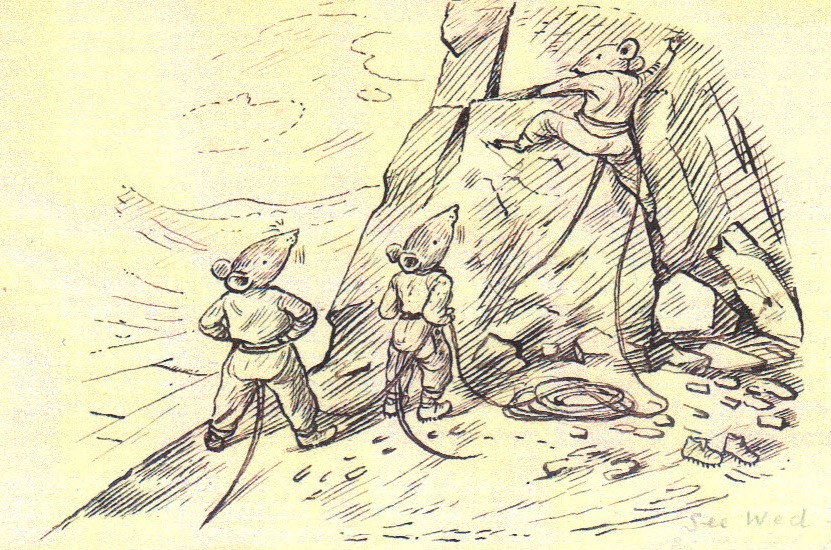
At some time during the later war years Evelyn illustrated two journals of climbing holidays in the Lake District written by Roger Folley, with all the protagonists featured as mice. The one below shows Roger Folley leading, Evelyn roped up to follow, and, bringing up the rear, their friend Glynn Burton. There's more about one of these expeditions here.


Pen and ink illustration from Roger Folley's An Episode in the History of the Lake District, 1941. The only original copy is in the Tate Archive.

Hardly great art, maybe not even the crumbs from the table of a greater banquet, but there's a certain charm and captivation in Evelyn's playfulness and sense of fun, mice or no mice.

Text ©Christopher Campbell-Howes 2017

  
Further reading...

          EVELYN DUNBAR : A LIFE IN PAINTING
 
                   by Christopher Campbell-Howes

                    is available to order online from:

                  customerservices@scriptps.co.uk

                448 pages, 301 illustrations. RRP £30