Standing by on Train 21 (1942)
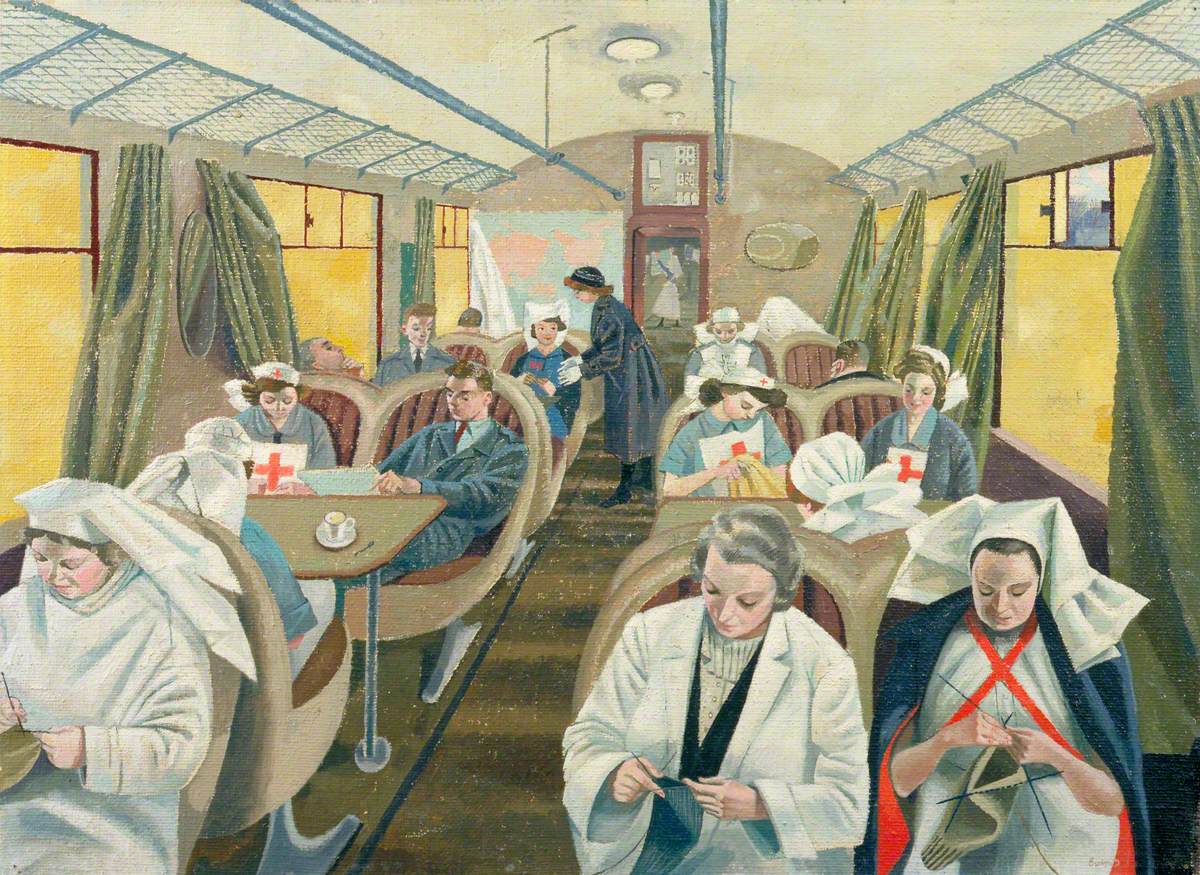
Standing by on Train 21 (1942) oil on canvas, 22 x 30 in. (55.8 x 76.2 cm.) Imperial War Museum, London
A Tale of Four Remarkable Women and the Green Identity Card
At the monthly meetings of the War Artists' Advisory Committee (WAAC) in 1939-40 discussion about the role of women artists in wartime appears to have been lively. Chaired by Sir Kenneth Clark (later to become Lord Clark, celebrated for his TV series Civilisation), the WAAC consisted of some ten leading figures in the world of British art, all men, with an average age of 51. They were open to suggestion: in February 1940 the first of our four remarkable women, Lady Florence Norman, a former suffragette who had managed a services hospital in France in World War 1 and who was a founder trustee of the Imperial War Museum, wrote to Ted Dickey, the WAAC secretary:
The Imperial War Museum [...] has once more the duty of recording a War. We have no funds for the purpose of paying artists. But much can be done by introducing artists to subjects and providing facilities for this work. [...] The calling up of a million women to substitute the work of men, points to the need of appealing to the patriotic sense of women [...] to serve and make sacrifices for this country. The Women's Services, at my suggestion, have each appointed a historian to collect records and I am asking that artists within their ranks should draw and paint what they see.
Dickey subsequently asked the Women's Voluntary Service (WVS) to submit areas of activity which might be depicted if women war artists were to be appointed. Some results appear to have been submitted very near to the time, mid-April 1940, of Evelyn's appointment as a war artist. The suggestions included images of women working on allotments and women supplying fresh vegetables to minesweeper crews. In her application the previous December Evelyn had stated her readiness to record 'women's agricultural or horticultural work, or anything connected with land work' with 'very keen understanding'.
The two WVS suggestions found a ready ear in Evelyn, for different reasons. Women working on allotments appealed to her innate horticultural interests, especially as it involved the replacement of men called up to fight, and at a more personal level the notion of delivering fresh vegetables to naval crews called strongly: her brother Alec, or more correctly Lieutenant Alec Dunbar RN, commanded a minesweeper converted from a herring drifter, then stationed in Sheerness, on the Medway estuary and thus not very far away from The Cedars, the Dunbar family home a few miles upstream at Strood. However, in view of the current war situation and the immediate probability of German bombing and gas attacks, Evelyn and her two fellow female appointees were sent on the recommendation of Lady Stella Reading, founder of the WVS two years earlier, to one of the WVS training centres, Bisham Abbey in Berkshire.
One senses a ferment in Evelyn's activity, set against the national background: the Conservative government led by Neville Chamberlain was tottering to its imminent fall, to be replaced by Winston Churchill; the now almost-forgotten war in Norway was going badly; Nazi incursions into the Low Countries and northern France were gathering momentum, with conquered French airfields facilitating bombing raids, later known as the blitz, into England, particularly London. Less than a week after her appointment on April 17th Evelyn was contracted to produce six WVS paintings, starting with Civil Defence operations, then under the WVS wing, at Bisham Abbey.
There was some delay while Dickey arranged and forwarded travel warrants and vouchers for artists' materials. It was a bad time for Evelyn; she was in the middle of what she called her 'crisis years', following the break-up of her relationship with her former Royal College of Art mural tutor Charles Mahoney and subsequent miscarriage. She had very little work, there was some family bitterness, and she had no money. For the previous twelve months she had worked behind the counter in her sisters' haberdashery shop at 168, High Street, Rochester, setting her employment against the family household expenses and for the rent of a studio above the shop. Now, against all expectation, was an opportunity to restart a career as an artist.
Anxious to justify her appointment, she managed to submit Putting on Anti-Gas Protective Clothing to the WAAC by mid-June. It was accepted with acclaim. However in early May another posting, overriding her original WVS contract, came from Dickey. In consultation with the Ministry of Agriculture and ever mindful of Evelyn's request for agricultural or horticultural work, he arranged, after some hurried re-arrangement of her placement, for her to report for duty to Sparsholt Farm Institute, near Winchester.
Nevertheless Evelyn proposed to fulfil, even exceed, her original WVS contract. In the hiatus between the completion of the sketchwork for Putting on Anti-Gas Protective Clothing and her new Sparsholt contract, she produced - on her own initiative - paintings of two further women's organisation activities. The first of these, A Knitting Party, was a part-actual, part-imagined WVS knitting session in her own home, with her mother Florence in a central placement. The second, A Canning Demonstration, took Evelyn a short bicycle ride up the Gravesend road to the village of Shorne, where the Women's Institute was hosting a demonstration of soft fruit preservation in the village hall. Another possible site for her brush lay a mile or two along the Brompton Farm road towards the village of Wainscott. Here something happened that served to alter the course of her WAAC employment, threatening even to blight it so soon after her appointment. To discover what it was we have to fast-forward some 70 years.
* * *
In 2013 a very large collection of Evelyn's work, some 800 pieces, appeared from almost forgotten storage in the cone of a Kentish oast house. This was her residual studio, which has become known as the Hammer Mill Oast collection: on Evelyn's death in 1960 her husband, Dr Roger Folley, collected most of it together and passed it on to the only Dunbar sibling with room to accommodate it. We have met him before: Alec Dunbar, no longer in Royal Navy uniform, but an entrepreneur living outside Maidstone in an extensive property called Mullion Court. Eventually the collection was passed on to Alec's son Alasdair, the owner with his wife Ro of the oast house. On Alasdair's death I was privileged to be invited to inspect the oast house collection, a huge but fascinating task. One category of Evelyn's residual studio was reserved for sketches of no outstanding artistic merit, but which she had kept all her life. Evelyn squandered her sketches. Whatever was needing to be sketched, a face, a leaf, a child playing, a profile, a feather, a garden tool and much, much more was studied repeatedly until she felt she had got it right, spreading her subject over any available corner of cartridge paper, whatever else was on it.
And here was a large sheet of cartridge paper, uninvaded by other subjects, carrying a landscape devoted to some allotments, with occasional detail and with - as was her usual habit - written descriptions of the colour, shade and texture, enough information to allow her to proceed when she came home from sketching and started work in her studio. Was this to be the fourth or fifth of her WVS-inspired images? Curiously, the upper quarter is blank, or with vague shapes not suggestive of anything, as though she proposed to add something else, in all probability details of the sky or hills beyond or...but we leave such speculation there. Here it is, with the scenario to follow. 'Allotments near Strood' is my title.

'Allotments near Strood' pen and ink, pencil. 1939 (?) Signed 'Evelyn Dunbar' Photograph ©Liss Llewellyn
In the summer of 1941 Evelyn applied to Dickey for a Green Identity Card, a permit which would authorise her to access low security level premises - and which might have avoided an unfortunate incident. Her need for a Green Identity Card was highlighted the year before, during the height of the invasion scare following the military disaster of Dunkirk. She had been along the road towards Wainscott, where the allotments covered a portion of hillside governing wide views over the river Medway and beyond, an ideal place for the next in her series of WVS-inspired scenes.
She stopped at a suitable point, set up her easel and began to sketch, being careful to include a woman in the foreground. (Perhaps we can note that in such studies figures which would be continually moving about would be added in later.) The sketch was reasonably advanced, with colours and textures noted when she was approached by a group of allotment gardeners who told her sharply to clear off; they wanted no truck with German spies, making drawings helpful to the enemy. This may not have been quite as fatuous as it sounds: from these allotments there was a view across the Medway estuary of the Royal Navy dockyard at Chatham. If there were threats of summary justice or of calling the police, they have not been recorded, but Evelyn retreated, aghast and shaken. What was she to do? I hope it may not be a conjecture too far to suggest that on returning home she signed her work - something she only did with finished work, and that not invariably - and pre-dated it by two years. Evelyn kept this sketch for the rest of her life, at first perhaps as a measure of self-protection, and later, once the dust had settled, as a souvenir of an amusing incident. In the wake of this she wrote to Dickey:
I wondered if they would give me a permit for working in places where I might otherwise be barred? If so, I should be very glad to have a permit of some kind, as, although the subject I am studying at present is nothing more secret than allotments in an area like this one I can hardly move without running into some kind of defence measure and as I have no official permit it is not always too comfortable.
Evelyn was granted her Green Identity Card, but almost at once her own plans for using it were eclipsed by a request, relayed by Dickey, from Edwina, Countess Mountbatten for some nursing pictures; the redoubtable Lady Mountbatten was shortly to be appointed Superintendant-in-Chief of the St John Ambulance Brigade and not to be refused nor postponed. Dickey's letter stated that the WAAC 'recommended that you be asked to paint some pictures of nursing subjects for a fee of thirty five guineas [...] It was particularly requested that a hospital train should be included among the subjects that you should deal with. Train No.21 was suggested as particularly interesting.'
So we arrive (at last) at the subject of this essay. Here is a reminder of it:
The rolling stock for this particular ambulance train had been acquired from London and North East Railway (LNER). Two carriages feature in Evelyn's response to Lady Mountbatten's request: the very fine carriage above, and a second, starker image which was to became the pair and complement to it, Hospital Train. The first has been identified as LNER 'Tourist Stock' 1938, No. 56856, identifiable by the striking design of the chairs. The carriage was originally placed next to the buffet car, for the greater comfort of the buffet customers. For Train 21 it has become the staff recreation area.
The woman in the central foreground is the doctor in overall charge of the train; a Dr Gibson, apparently, but none of the figures should be taken as portraits. Beside and behind her are nurses from various nursing organisations: the blue-cloaked nurse on the right belongs to the Civil Nursing Reserve; the woman on the left is a member of one of the religious nursing orders. Most of the others belong to the Red Cross. A lot of knitting is going on, comforters and balaclavas: Evelyn is painting in October, and winter will be coming on, as hinted by the view through the open window, confirming that a sense of season is never far away in so much of Evelyn's work. In the far distance a nurse is hanging up washing. There are several male orderlies, apparently in RAF uniform, perhaps seconded from military hospitals. A WVS member, standing in the middle of the corridor, may be asking the nurse looking up at her if she takes milk in her tea. There is an air of calm, of order and assurance. No one is talking much. Indeed one of the male orderlies, fourth from the left, appears to have fallen asleep. The hospital train is ready to move into action.
For all this, such hospital trains were rarely used. Perhaps alone of Evelyn's war paintings, Standing by on Train 21 is largely cosmetic. Its partner, Hospital Train, while less attractive as an image, tells a more open and compelling story. In any case, as the intensity of the blitz diminished hospital trains were put to other uses or broken up. By 1944 some had been adapted as military hospital trains for bringing the wounded back from theatres of war in France and Italy.
Evelyn appears never to have returned to those allotments.
Warmest thanks to Rev. Dr Amanda Stevens and to Paul Liss for their contributions.
Text ©Christopher Campbell-Howes 2026
Further reading:

EVELYN DUNBAR : A
LIFE IN PAINTING by Christopher Campbell-Howes
448 pages, 301 illustrations. £30
Order from: customerservices@scriptps.co.uk
No comments:
Post a Comment